James Cole: My Favorite Innkeeper of Plymouth MA

James Cole was the first of the Cole ancestors to immigrate to America and he founded the Cole lineage starting in the Plymouth Colony and spreading across to Virginia and beyond. James Cole and Mary Tibbes are my Eleventh Great-Grandparents! I can hardly believe I was able to go so far with my research! Learning about James Cole made him my favorite innkeeper and person in Plymouth, Massachusetts! Read on to see his story!

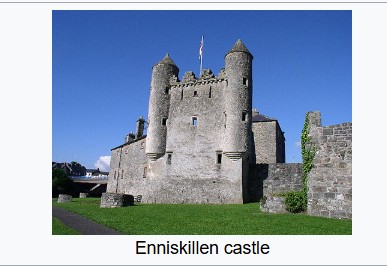
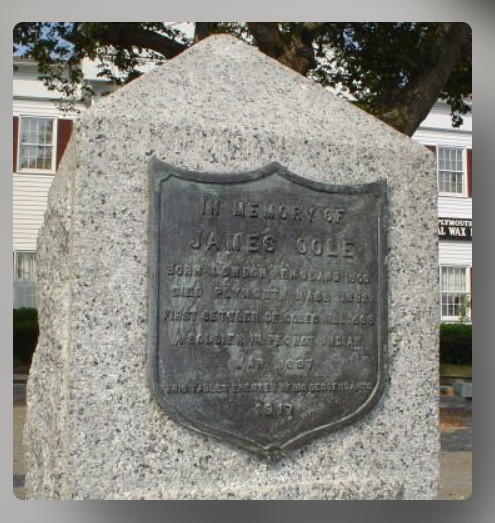
James Cole was born in London, England on 25 July 1600 and in 1616, at sixteen years old, he lived in a suburb of London called Highgate with his family. James was the son of William Cole, also known as William James Cole, an Englishman who was born about 1570 in Enniskillen, Fermanagh, Ireland. William Cole was likely married first to Susan Bale, born about 1564 in Littlebentley, Essex, England but Susan may have died because William later married Mary Feake/Feakes about 1598 in London. According to this, Mary Feake is the mother of James Cole.

I found a bit of history of the Cole family. “The surname Cole is derived from an ancient name of unknown antiquity. Coel, as the name was formerly spelled, was the founder of Colchester, England and was one of the kings of Britain. The American family is believed to belong to the Hertfordshire branch. At the time of King James, when the thrones of Scotland and England became one, the Cole family was loaded with additional honors and estates…At this time Sir William Cole, father of James, was established in Ireland by the King and given immense estates at Enniskillen.” (Wikitree citing William James Cole 1570-1634).

The English campaign in the early 1600s aimed to bring the province of Ulster, Ireland under English control. The English captured the Enniskillen Castle in 1607 and the lands of the native Irish were seized and handed over to planters loyal to the English Crown. William Cole from Devon was appointed by King James I to build an English settlement there in 1612. Captain William Cole was installed as Constable and strrengthened the castle wall and built a “fair house” on the old foundation as the center point of the county town. The first Protestant church was erected and by 1630 the town had around 180 inhabitants, mostly English and Scottish settlers. There is a Cole monument in Enniskillen one hundred feet high and can be climbed to give a view of the town.
Now that we have a picture of the histoical background of James and his father, we can continue to explore his life from London to Enniskillen, Ireland to Plymouth MA immigrant. James Cole married Mary Tibbes on 8 May 1625 in Barnstable, Devon, England. Mary was likely the daughter of John and Margaret Tibbes (Tibbs). Not much more is known about Mary Tibbes.

James Cole and his wife Mary and two of their children immigrated in 1632 and may have come to Saco, Maine and then made their way to Plymouth or they landed at Plymouth. Records confirm James Cole was listed in the 1632 census for Plymouth MA although 1633 is used as the year of immigration and admittance as a freeman. His name is on the tax list of Plymouth in 1634 and in 1636, he had a grant of ten acres of land and then received another seven acres for his dwelling house. James was a mariner or sailor, shoemaker, surveyor and Innkeeper and he built his house on the sight of the present Baptist Church in Plymouth.

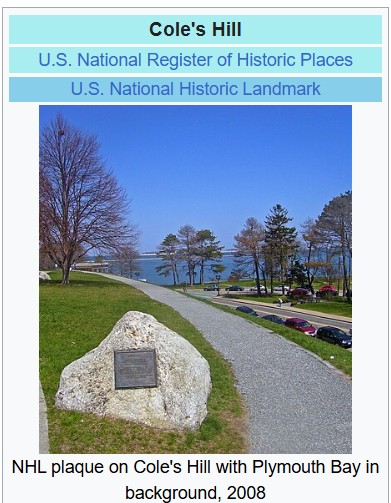
James was the first settler who lived on “Cole’s Hill”, as it is still known, the first burial ground of the Pilgrims. This land probably included the ground upon which rests Plymouth Rock. Cole’s Hill is now a National Historic Landmark! James accumuated more land from grants through the years and served as a surveyor of highways in several years, a constable in 1641 and 1644, and served on a number of juries. In addition, James was a volunteer in conflicts with the Pequot Indians.
Moving on to one of the more interesting and noted occupations of James Cole which was his job as an innkeeper! Soon after his arrival at Plymouth, he opened the first inn called an “ordinary” or public house which was one of, if not the first, public house in New England. This house was kept as a public house by him and his son James until 1698. An occupation of an Innkeeper was of considerable importance because the state and community recognized the need to provide comfortable lodging, food and drink for visitors. James Cole became Plymouth’s best known innkeeper with his establishment on Cole’s Hill on the north side of Leyden Street. In 1657, 1659 and again in 1669, the court awarded him ten pounds to repair his inn so it would be fit for visitors and kept in good repair.

However, James was not always the upstanding citizen. Of particular interest is his apparent lack of church membership among the scores of early prominent settlers who were often church leaders! Not only did he avoid church, but also operated a rather rowdy tavern! He was fined several times for selling wine to the Indians. One account describes the throwing of stools and general disturbance until early morning hours! James violated his liquor license and lost the license for allowing drunkeness and disorder in his tavern but continued to run the inn without the license as he was apparently financially successful anyway. Even after his license was restored, he and his wife experienced some troubles running the inn and were sometimes fined. Indeed, James appeared in Plymouth records for either being drunk or allowing others to become drunk in his house. He later relinquished operation of the inn to his son James who ran a quieter operation!

Despite his tavern escapades, James was financially successful and acted as surety on bonds at various times and loaned money. He undoubtedly won the respect of the townspeople. He also appeared numerous times in court records as either a plaintiff or defendant in various actions involving business contracts and debt collections. I think James was a bit of a rebel and non-conformist but had a good heart and helped his neighbors and friends. Living in a strict religious community had to be a challenge for his rebellious spirit!

James and Mary Cole had four children including the following:

1. James Cole, born 1626/27 in London, England and married (1) Mary Tilson in 1652 in Plymouth MA and had seven children. He married (2) Abigail Davenport in 1700 or later. James died 4 October 1709.

2. Hugh Cole, born 1627 in London, England and baptized in 1628. He married Mary Foxwell in Plymouth in 1654/5 and had twelve children. Hugh is our ancestor and his story can be found here:Tracing Roots of Hugh Cole II and Deborah Buckland Families

3. John Cole, born about 1630 In Plymouth MA. Died 1677.

4. Mary Cole was born about 1632. she married (1) John Almy by 1668 and (2) John Pococke by 1677. She had no known children.

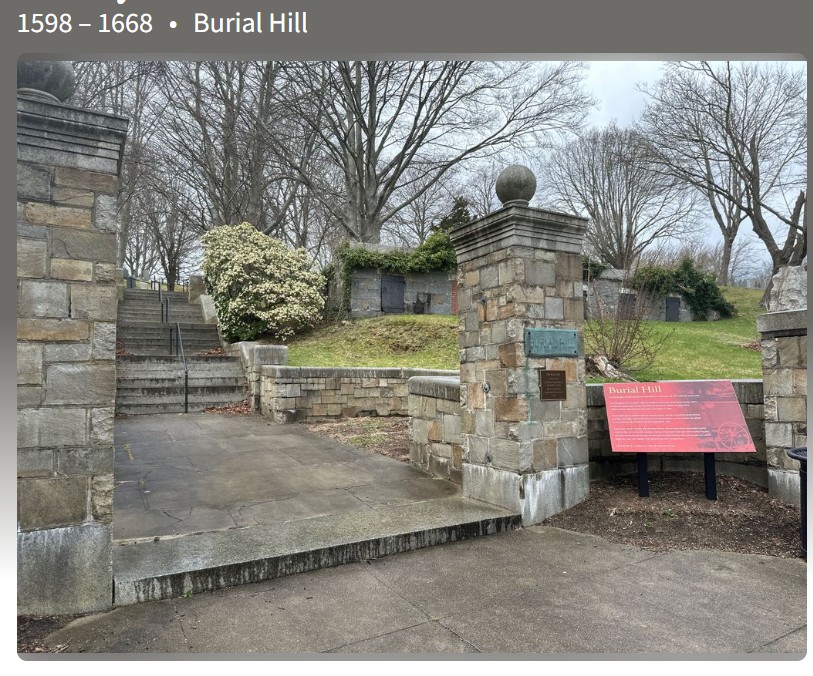
James Cole died 12 October 1688 in Plymouth MA. Mary Tibbes Cole died 7 Mar 1660. They are buried in Burial Hill in Plymouth also called Cove Burying Ground.
Sources:

Ernest Byron Cole, The Cole Family of Plymouth, Mass. p. 325.

England, Select Marriages, 1538-1973; Database online: Ancestry.com

Robert C. Anderson. The Great Migration Begins; Database online: Ancestry.com: Also: Robert C. Anderson. The Pilgrim Migration. Boston: Hew England Historic Genealogical Society, 2004.

Massachusetts, U. S., Compiled Census and Census Substitutes Index, 1790-1890, Database online: Ancestry.com

Ernest Byron Cole. The Descendants of James Cole of Plymouth 1633. New York: Grafton Press, 1908.

Supplement II to Three Hundred Colonial Ancestors, p. 13; Ancestry.com

Robert S. Wakefield and Alice H. Dreger. The Wives and Children of James Cole of Plymouth, Massachusetts. The American Genealogist 67 (1982): 243-45

Find A Grave, Mary Cole, Memorial 128251542; Also: James Cole, Memorial 34205577

Wikipedia. Citing Enniskillen, Fermanagh, Ireland.
Tracing Roots of Hugh Cole II and Deborah Buckland Families

In my efforts to sort out all the Hugh Coles in my ancestry, I am trying to find interesting stories to share! This generation of Hugh Cole II and Deborah Buckland was interesting because of the ancestry of Deborah Buckland that we can trace back to England and because family of Hugh II was involved in King Phillip’s War. This couple are my 9th Great-Grandparents. Read on for more!

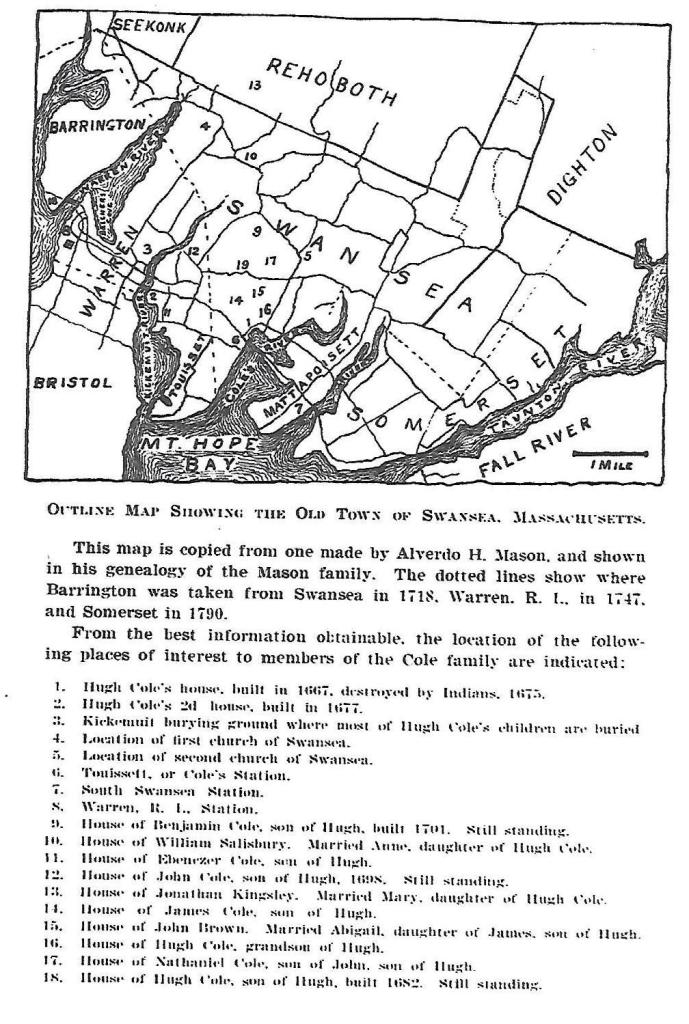
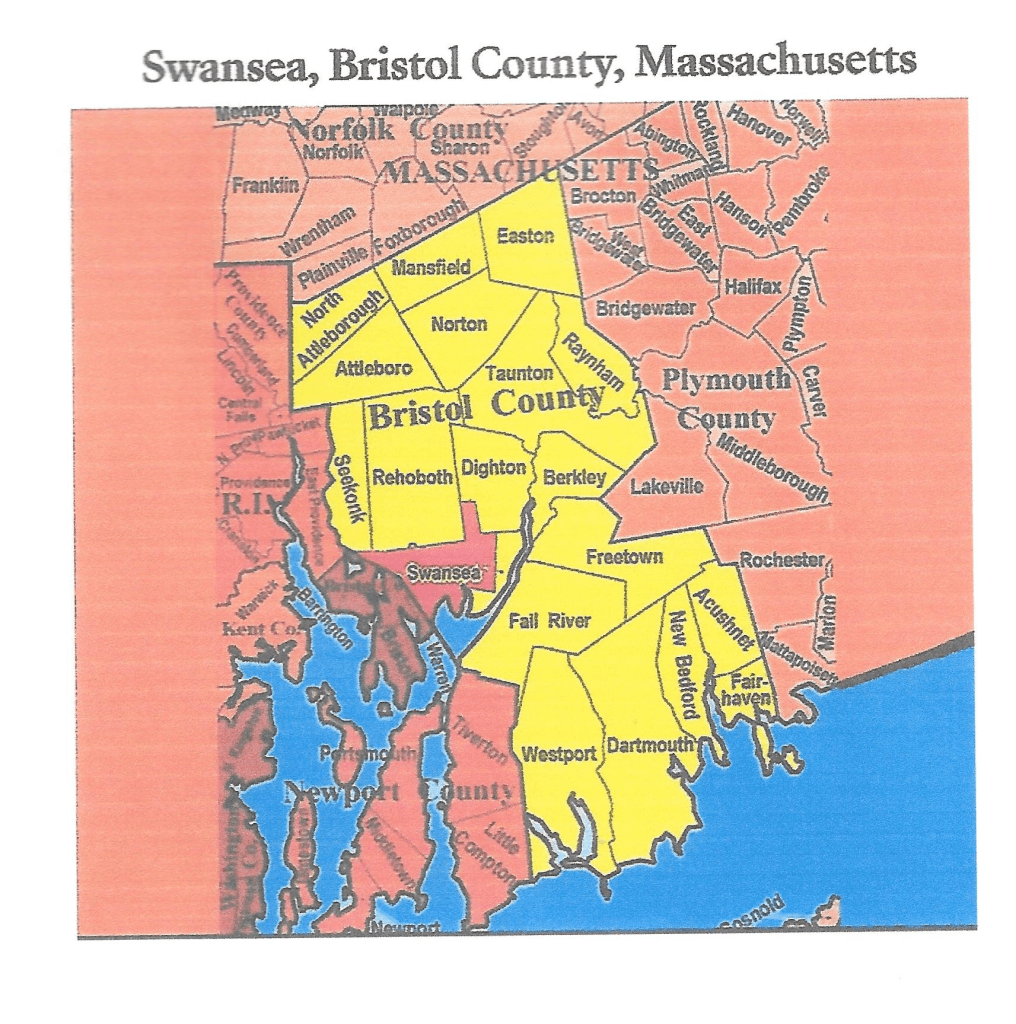
Firstly, regarding Hugh Cole II, he was born 8 March 1657/58 at Plymouth, Massachusetts Bay Colony and was the son of immigrants Hugh Cole I and Mary Foxwell. In 1680, Hugh II was admitted as a freeman in Swansea and then began building a house in Swansea in 1681. Amazingly, the house is still standing with some additions having been made to it!

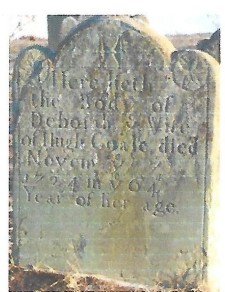
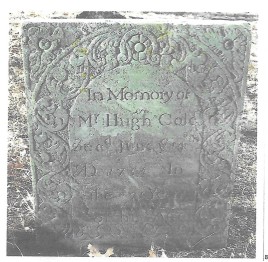
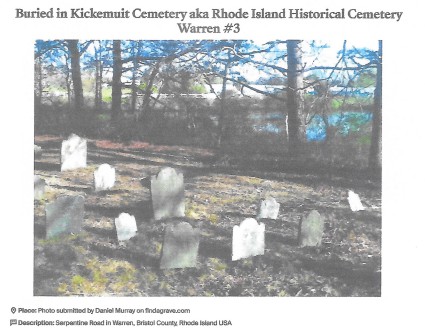
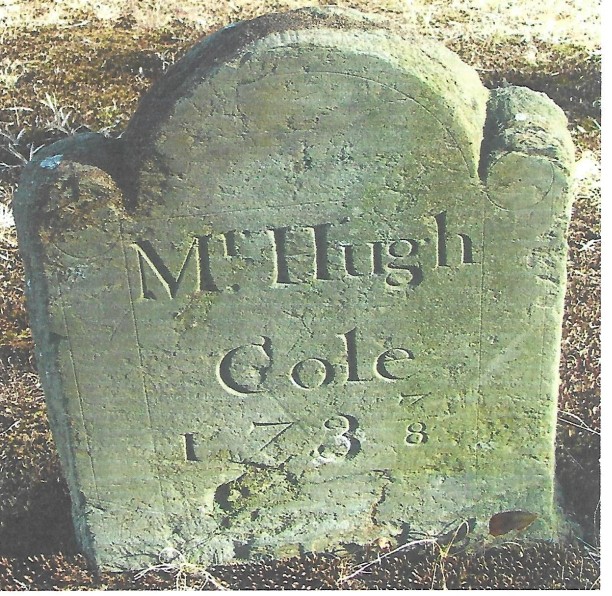
That same year, 1681, on May 6th, Hugh II married Deborah Buckland in Swansea, Bristol County, Massachusetts Colony. Deborah was the daughter of immigrant Joseph Buckland (also spelled Bucklin) and Deborah Allen. Deborah died 7 November 1724 in Swansea at age 64 and he husband Hugh II died 17 February 1737-38 in Swansea at age 80. They are buried in Kickemuit Cemtery, Warren, RI. Their grave markers are pictured below.

Cole Roots

Now to first trace the roots of Hugh Cole II. His father, Hugh Cole I, was born about 1627 in London, England and was the son of James Cole and Mary Tibbes. Hugh I came to Plymouth MA with his father James and mother in 1633 when he was about six years old. From Plymouth records, I found James Cole and son Hugh kept the cows for the community from April to November by bringing the cows to pasture and back for milking. They were paid 50 bushels of corn for this! Later, as an adult, he was admitted as a freeman in 1657 in Plymouth Colony.

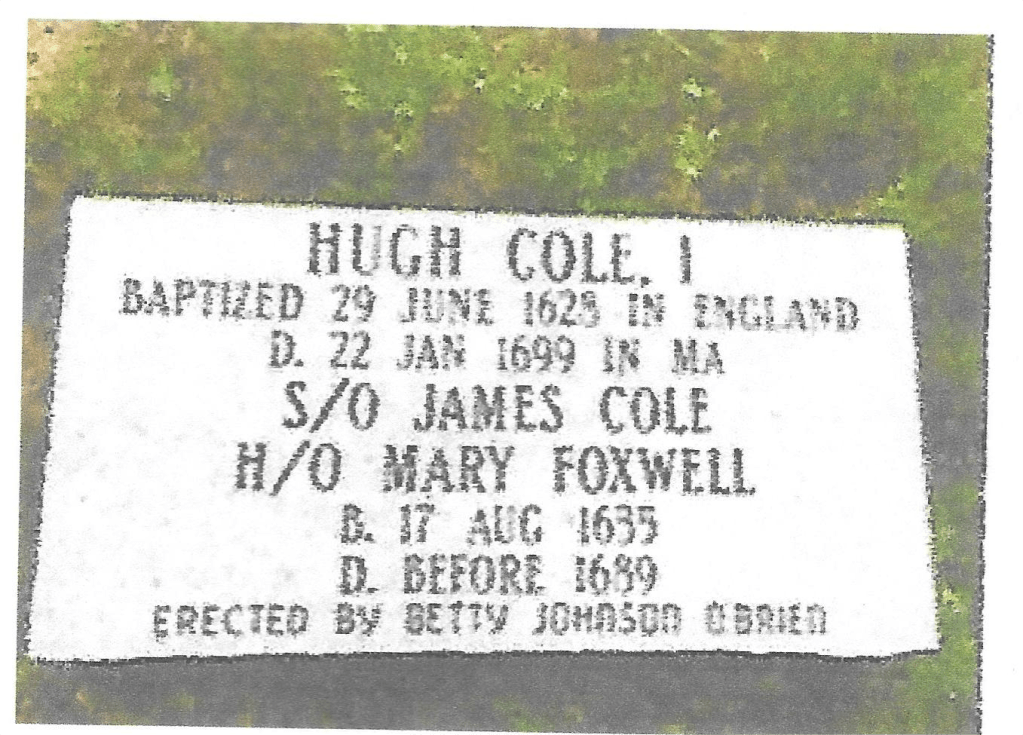
He married Mary Foxwell, daughter of Richard Foxwell and Ann Shelley, on 8 August 1654 and they had ten children. Mary Foxwell was born in 1635 in Scituate MA and she died in 1688-89 in Swansea at age 53. She was Hugh’s first wife and he married twice after that but all the children were by his first wife Mary. She was buried in Tyler Point Cemetery in Bristol County, RI and her grave is unmarked but a marker was placed in 2015 commemorating her and her husband.

Hugh I was a shipwright (ship builder) and civil engineer among other things. He also was a surveyor of highways in Barnstable, a selectman in Swansea and a deputy to the General Court. Some sources also list his occupation as shoemaker, innkeeper and sailer. Indeed, a jack of all trades!

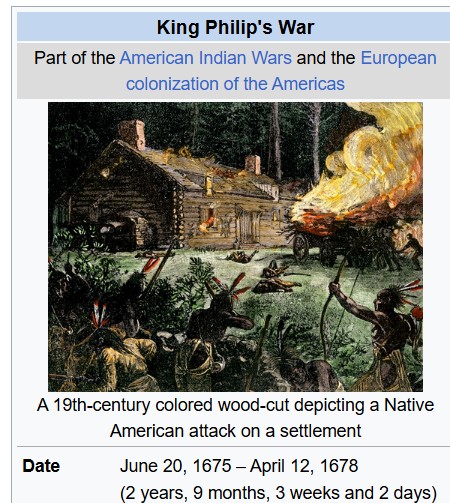
The Cole’s lived at the time and place of King Phillip’s War when Native American tribes of the Northeastern Woodlands plundered and killed settlers in an attempt to drive the colonists away. In this calamity of war, 12 of the region’s towns were destroyed and many more damaged. The economy of Plymouth and Rhode Island Colonies was ruined and their population decimated after losing one-tenth of all men for military service

Hugh I had also purchased 500 acres from Native American leader, King Phillip. During the King Phillip’s War, Hugh’s own home was burned and he served as a Sargeant in the conflict. He and King Phillip were actually good friends and when the King warned him that he could no longer keep his braves under control, Sergeant Cole loaded his household goods and family on a raft and left for Tiverton, Rhode Island where he had friends. His home was afire in less than an hour, but he returned about 1680 and built a new house.

Hugh Cole I died in Swansea, Bristol, MA on 22 January 1698-99 and was buried in the southern part of Meadow Neck in the Tyler Point Cemetery next to his wife. The cemetery is now called Howland Meadow.

Buckland Roots

Joseph Buckland, father of Deborah who married Hugh Cole II, was indeed an immigrant but he came to America as an infant in 1634 from England on the ship “Elizabeth Dorcas” along with his mother from Weymouth, Dorset, England where Joseph was born on 26 Jun 1633. His parents, if we can go back a generation, were William Buckland and Mary Bosworth.

A sad story comes out of this journey to America in 1634 on the “Elizabeth Dorcas.” From what I can gather, William Buckland, a carpenter and shipbuilder, had already traveled to Plymouth in 1630 with the Winthrop fleet, but returned to England to bring his wife, Mary Bosworth Buckland, and family back to Plymouth. The Buckland clan coming by ship in 1634 included William and William’s wife Mary, their infant son Joseph Buckland, her mother Mary Bosworth, and her brothers and her father, Edward Bosworth. Here is the sad part, Edward Bosworth died on board ship, just as it landed in Boston Harbor, never to set foot on the land of his choice! The Bosworth Genealogy states that Edward, being close to death, asked to be carried to the deck, “so that he might see the promised land, and after this, consigned his soul to God, and died.”

The Buckland family first settled in Hingham, Massachusetts and by 1656, William Buckland, who was a shipwright, moved his family to Rehoboth, MA. Joseph Buckland married Deborah Allen on 5 November 1659 in Rehoboth, Bristol, MA, British Colonial America. This Deborah Allen was the daughter of John Allen and Elizabeth Bacon of England of whom no further information is verified or written. Deborah Allen was born about 1637 in Huverton, Leicestshire, England and it is assumed she immigrated with her parents.

Joseph Buckland died on 28 Mar 1718 in Rehoboth, Bristol, MA. Deborah died there two years later in 1720. They are buried in Newman Cemetery, East Providence, RI.

William Buckland died in 1683 and Mary Bosworth Buckland was buried in1687, four years later. They were buried in Rehoboth MA and their son Joseph administered his father’s estate.

Sources:

First Families of America, database, Ancestry.com, p. 117.

Massachusetts Vital Records, 1621-1850 & Plymouth Vital Records, p. 670: AmericanAncestors.com, NEHGS

Find a Grave for Hugh Cole: Memorial 9258336

Cole, Ernest Byron. The Descendats of James Cole of Plymouth 1633. Grafton Press, New York, New York, 1908, pp. 25-27, 32-34.

W. R. Cutter. New England Families, Genealogical and Memorial. 1914, Vol. II, p. 630

James Newell Arnold. Vital Record of Rehoboth, 1642-1896: Marriages, Intentions, Births, Deaths…etc. p. 65. Digital copy from http://www.archive.org.

WikiTree for Joseph Buckland (1633-1718)

Ancestry.com, New England, The Great Migration and The Great Migration Begins, 1620-1635 [database online]. Provo, UT, USA: Ancestry.com Operations, Inc., 2013.

Savage, James. A Genealogical Dictionary of the First Settlers of New England Boston, Little Brown and Co., 1862, Vol. 1, pp. 416-429.

England, Select Marriages, 1538-1973; database online at Ancestry.com.

Hugh Cole III and Martha Luther of Swansea MA: First Baptists of the Cole Clan

When I started years ago to research my family’s genealogy, I never dreamed I would find ancestors beyond Great-grandparents. Here it is years later and I have found so many that lived so very, very long ago. Hugh Cole III and Martha Luther were my 8th Great-Grandparents and I have even researched beyond them and indeed to the Mayflower and beyond! It is quite a journey meeting all these ancestors and I don’t want to look at them as just names and dates but have strived to find out something about their lives. Even if it is just a blurb in a record, it gives me some insight about them and makes them much more real than just a name!

Hugh Cole III and Martha Luther were the parents of Joseph Cole Sr who married Freelove Mason. Their son, our ancestor, was Joseph Cole Jr. who I have written about in several posts! Hugh Cole III was born 30 May 1683 in Swansea, Bristol, Massachusetts, British Colonial America. He was the son of Hugh Cole II and Deborah Buckland/Bucklin. His line descends from James Cole of 1633. Some other Coles in early Colonial America have descended from a Daniel Cole. These are two separate Cole families that eventually intermarry. I am related to both clans of Cole!

Hugh Cole III married Martha Luther, daughter of Reverend Samuel Luther and Mary Abell on 13 December 1705, location unknown, but probably in Swansea. Martha’s father was the son of Captain John Luther, emigrant. Martha was born 9 December 1681 so was 24 years old at the time of marriage and Hugh was 26 years old. They had seven known children together between 1706 and 1727: Hugh Cole IV, Nehemiah Cole, Joseph L Cole (Sr. – our ancestor), Martha Cole (m. Edward Hoar), Peleg Cole (m. Priscilla Winslow), David Cole (m. Anna Childs) and Deborah Cole.

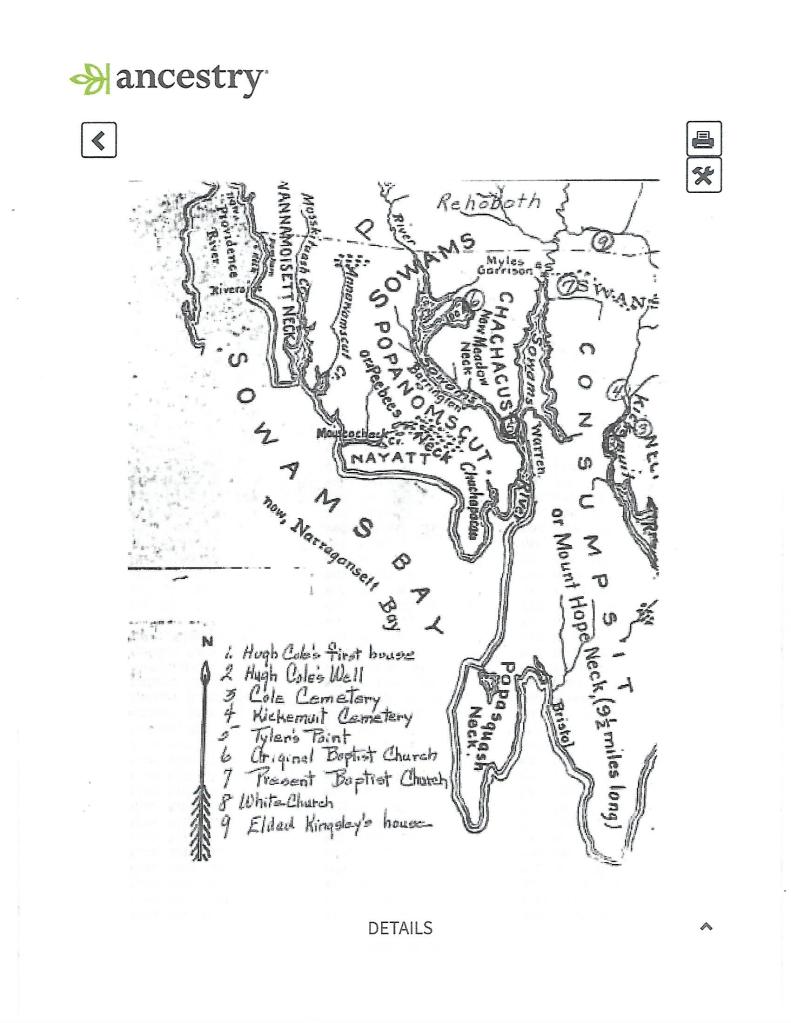
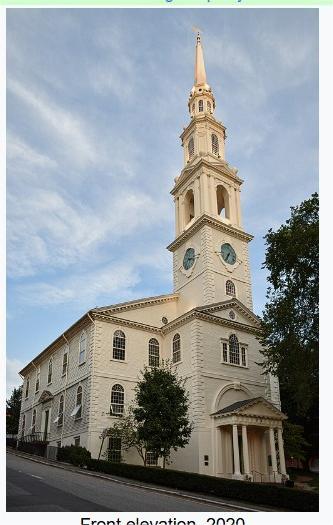
An interesting bit I found related to Hugh and Martha is about the first Baptist Church in American Colonies. Warren, Massachusetts was originally part of Swansea but was annexed to Rhode Island became a town in 1747. For a while the Puritan Church was a “state power” and would tolerate no other opinions regarding religion. Roger Williams opposed this and moved to Providence, Rhode Island where he established the first Baptist Church in America in 1638. His beliefs were based on the principles of soul freedom and separation of church and state. The Coles of Swansea, including Hugh and Martha, chose to attend the Baptist Church as did many of their descendants for years to come! Below is the Baptist Church today.

Hugh Cole III died on 16 July 1753 at age 70 in Swansea and left a will. His son Peleg Cole was administrator of his estate which was divided between his wife and children as to his wishes “to provision for the Use of ye Family.” Martha Cole died in 1765 at age 83 or 84. Martha and Hugh Cole III are buried in the Kickemuit Cemetery, Warren, Bristol County, Rhode Island.

Links to related posts: A Difficult Fresh Start for the Cole Families

Joseph Cole Sr. and Freelove Mason: From Swansea MA to St. Clair VA!

SOURCES:

  • The Blankenbeckler Family of Southwest Virginia and Related Families, Database, Ancestry.com., 2005, pp. 78-79.
  • First Families of America, (Cole, Remond Selecmon), p. 117, Database, Ancestry.com
  • U. S. & International Marriage Records, 1560-1900; database, Ancestry.com
  • Massachusetts Births and Christenings, 1639-1915, Database, FamilySearch, Martha Luther; FHL 0903395, Item 6.
  • Abstracts from Bristol County MA Probate Records, 1745-1762; Vol. XIII, pp. 137-8; Vol XIV, pp. 227-8, 154.
  • The Cole Genealogy; Descendants of James Cole of Plymouth 1633; by Earnest Byron Cole: Grafton Press, NY, 1908; pp. 42-55.
  • Horace A Abell and Lewis P Abell, The Abell Family in America: Rutland, VT: Tuttle Publishing, 1940, p. 47.

Joseph Cole Sr. and Freelove Mason: From Swansea MA to St. Clair VA!

Joseph Cole, Sr. and Freelove Mason were my 7th Great-Grandparents and parents of Joseph Cole Jr. who married Freelove Cole Thomas. I discovered the Cole ancestors when researching my Mayflower connections. I have multiple Cole ancestors – a surname closely associated with Plymouth and the Mayflower descendants and this creates a challenge for reseaching the Cole families. For more on this family, see my stories about Joseph Cole Jr., son of Joseph Cole Sr. and Freelove Mason: A Difficult Fresh Start for the Cole Families and Tribute to Capt. Joseph Cole Jr. – Revolutionary War Ancestor.

Joseph Cole Sr. was born on 3 May 1716 in Swansea, Bristol County, Massachusetts Colony in British Colonial America. He was the son of Hugh Cole III and Martha Luther. (Hugh Cole III was the third Cole in a line that was named Hugh, as you might have guessed!) Martha Luther also came from a very interesting family too with quite a few characters and I hope to write more about the Luther’s later! Her father was the Reverend Samuel Luther.

Freelove Mason was also born in Swansea on 14 November 1720 and she was the daughter of Joseph Mason and Elizabeth Barney. She and Joseph Cole Sr. married on 1 May 1738 in Swansea. A 1738 land record shows the Joseph’s father, Hugh Cole III, sold the newlyweds 10 acres with a shop in Swansea. However, in 1751 Joseph had land in Swansea that he sold to Martin Luther for 850 pounds as Joseph moved his family to Providence, Rhode Island in about 1749. The family moved again to Scituate, RI about 1758 when he was admitted as a freeman there. Land records show on 1 May 1758, he bought 65 acres in Situate but that land was later sold.

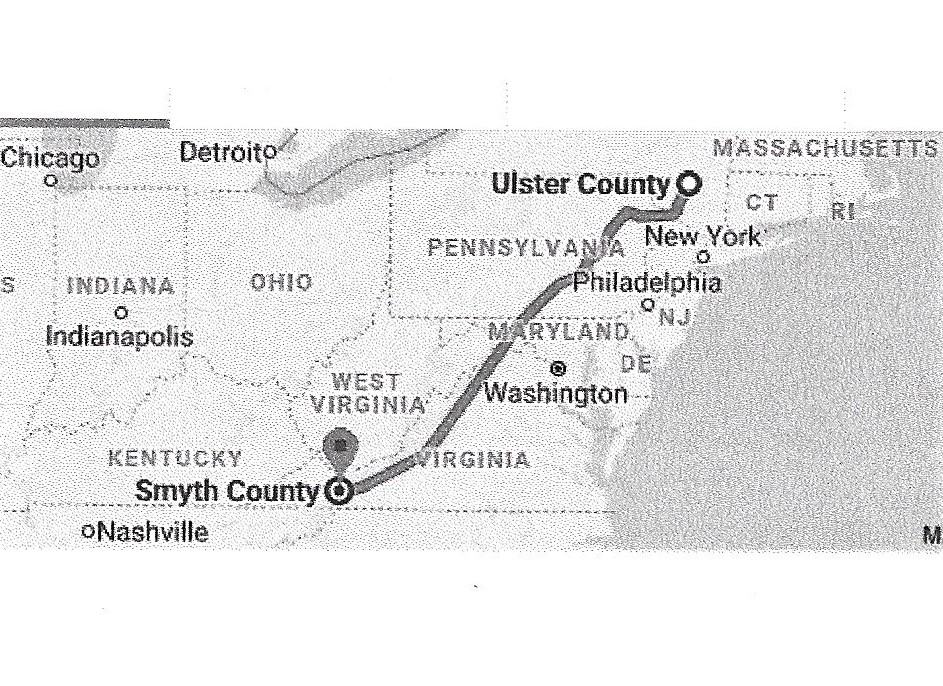
The Cole’s were of the Baptist Faith and their next move was to Poughkeepsie, Dutchess Co., New York Colony where a branch of Swansea’s Baptist Church had been formed. They resided in the New Paltz area of Ulster County, New York. Sometime between 1771 and 1774, Joseph Sr. and his wife and children journeyed by boat down rivers with families and relatives, including others of the Cole clan, from New York City to a remote corner of Virginia, bordered by Kentucky and North Carolina, to the Washington County area.

There is a story regarding the migration of the Cole family to Virginia that was carried down through the generations. When the relatives were getting aboard the boat at New York to sail for Virginia (probably Norfolk VA), one of the party, Dorcas Cole, was very much alarmed by the sight of so much water, and cried out, “We will all be drowned, we will all be drowned!” (she was a Baptist). Her brother Eleazer Cole (who was a Methodist Minister), remarked to her, “Stick to your faith; if you are born to be drowned you will be and if not, you will not.” That was the Baptist doctrine. Below, a map gives an idea of the long journey they embarked on!

The Joseph Cole Sr. family and their children settled in Washington County VA and on the South Fork of the Holston River. This area of the Holston River was known as Sinclairs or St. Clair Bottom, named after an English Settler, Charles Sinclair, who was granted the first patent issued to anyone in that region by the Governor of Virginia. Until 1776, the entire area of Virginia Colony west of the Blue Ridge Mountains to the border of Kentucky was known as Fincastle County. By 1776, this county was dismembered and three new counties were made of the area including, Washington, Montgomery and Kentucky Counties. Charles Sinclair died about 1776 and land was passed to his sons who conveyed a large portion of this land to Joseph Cole Sr. and his son, Joseph Jr., in multiple transactions over the years.

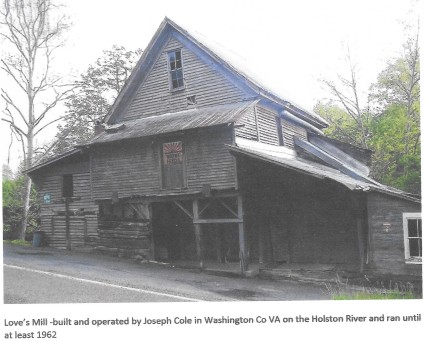
Besides acquiring lands, Joseph built a Grist Mill, called Loves Mill. Amazingly, this mill was still in operation in 1962! It was rebuilt around 1837 and the photo below is the rebuilt mill. It is in the town of Loves Mill in Washington County VA near Chilhowie.

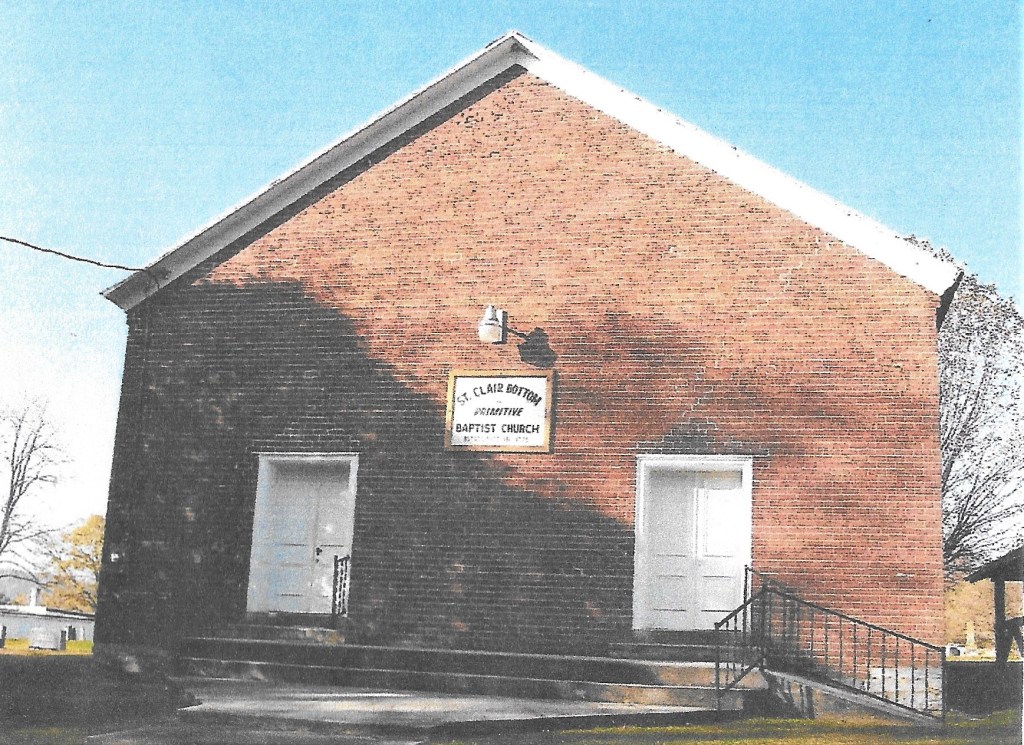
Now we are coming up to the time of the Revolutionary War and Joseph served as Corporal in the 4th Regiment of Virginia. He is a DAR Ancestor (#A203135) and recognized for his service to the country. Joseph served on the Grand Jury in Washington County also. As mentioned above, the Coles were of the Baptist faith and in Virgnina, they participated in establishing a Baptist congegation of which the Coles were the principal communicants. As a matter of fact, in 1792, their son, Joseph Cole Jr., donated by deed the land on which a church house was built and cemetery established in St. Clair Bottom. This was the beginning of the Primitive Baptist Church and Cemetery in St. Clair Bottom.

Joseph and Freelove raised possibly nine or ten children. Children I found named were: Lydia, Joseph Cole Jr, Susanna, Zacheus, Urania, Hannah, Sampson, Hugh, Joanna and Elizabeth. Some records also include a John Cole as a son and some records do not name Susanna or Hannah.

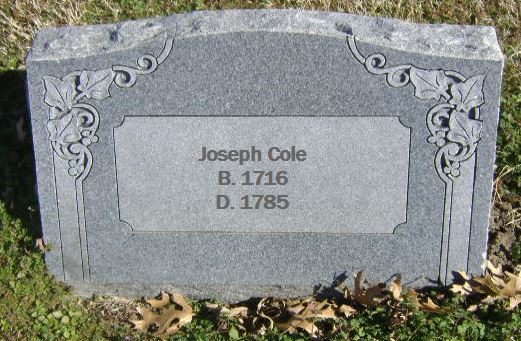
Joseph Cole Sr. died on 22 April 1785 in Chilhowie, Smyth County, VA. By this time, Washington County was also divided and part of it became Smyth County. Freelove Mason Cole died in 1792 and it is believed that Joseph and Freelove are buried in St. Clair’s Bottom Primitive Baptist Cemetery in the back under a pine tree. A memorial gravestone was later erected to honor Joseph Cole Sr. in the Baptist Cemetery for his military service.

Joseph Cole’s will, dated 22 april 1785, left everything to his surviving wife, Freelove, and upon her death, the children would each inherit land or money. His will did note that his son Hugh was deceased at the time of the will and other children mentioned in the will were Joseph Jr, Samson, Elizabeth, Urania, Lydia, and Zacheus. Not mentioned in the will were Susanna, Hannah and Joanna and John.

Sources:

Find A Grave.com, Joseph Cole

Redmond Cole, Mayflower Briefs

Descendants of James Cole of Plymouth, by Barbra Frisby Thompson, Mountain View CA, 2000

Luther Family Genealogy by George Luther

U.S. Revolutionary War Rolls, 1775-1783, Ancestry.com database

Summers, Annals of SW Virginia, part 2, p. 1124

Washington County Will Book 1, page 103

U.S. & International Marriage Records, 1560-1900; Database on Ancestry.com

Massachusetts Births and Christenings, 1639-1915; Database, FamilySearch

Women Ancestors and Sad Stories: Porter, Ewing and Lindsay

While researching ancestors, I find one of the biggest challenges is to find any information on the women who are related to me. I usually can uncover some clues on the men through tax records, land records, wills, etc. However, women had little rights and written records on many of them seem to be scarce. Mostly you have to depend on bits of information from researching the men they were associated with, like fathers, brothers and husbands. I was continuing my research on the Porter and Ewing lines for Capt. Robert S. Porter and his wife Margaret Lindsay with a focus on the women in the family.

Robert Porter was the only son and child of Andrew Porter and Eleanor Ewing who were my 7th Great-grandparents. His parents were Scot-Irish immigrants from the province of Ulster, Ireland in the1700’s. Eleanor Ewing was my first challenge but I found her parents who were Alexander Ewing and Rebeckah _____. (You can read more about them here: The Ewing Clan in History and Legend: Of Eagles Wings.) Eleanor Ewing was born about or before 1721 and we can assume she got married to Andrew Porter between the age of fifteen and eighteen before 1737. Their son, Robert Porter was born around 1737-1738. Her father, Alexander Ewing wrote his will in about the same year of 1738 when Eleanor gave birth to son Robert but Alexander had all his children named in his will EXCEPT Eleanor! It is believed that Eleanor died before her father wrote his will. It is believed that she died in childbirth or shortly thereafter from complications of childbirth. Further evidence of her death is that her husband Andrew remarried shortly afterward to Margaret Leiper. Robert was raised by his step-mother Margaret and with six half-siblings. Now I have a good idea what happened to Eleanor, wife of Andrew Porter and why her records were non-existent after 1738!

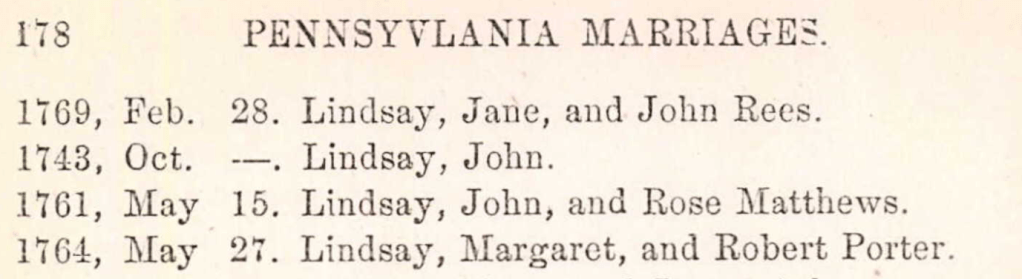
When this Robert Porter grew up, he married a Margaret Lindsay. Finding information on Margaret Lindsay led to another challenge! Their marriage record was a start of the paper trail. They were married 27 May 1764 in Pennsylvania.

Marriage Record of Robert Porter and Margaret Lindsay (Pennsylvania Compiled Marriage Records)

The AGBI (American Genealogical-Biographical Index) database listed Margaret Lindsay as being born in 1740 but another record places her birth as 1745. No where was there a listing of her parents. After searching through several Lindsays in that time period and in Pennsylvania, I found a will of James Lindsay who named a daughter “Margaret Porter” in his will and he lived in Middletown, Delaware County, Pennsylvania.

Excerpt from will of James Lindsay naming daughter Margaret Porter (Delaware, Pennsylvania Will Book )
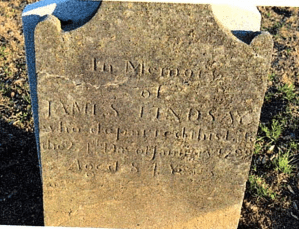
Gravestone of James Lindsay

This James Lindsay was born in South Leith, Midlothian, Scotland to William Lindsay and Agnes Broun according to his baptism records. He was born 03 Dec 1698 and baptized 05 Dec 1698. However his gravestone puts his birth more like 1808 if his age is correct on the stone. He immigrated to Pennsylvania about 1725 and settled there as tax records indicate. He married a woman named Elizabeth according to his will and some believe her surname may have been Ewing. James lived to 1792 and died at about 83-84 years old. He was buried in Middletown Presbyterian Church Cemetery, Elwyn, Delaware, PA. No record of his wife’s death has been found although she was still living when his will was probated in May of 1792. I assume she was buried in the same cemetery as her husband.

I believe it is quite possible that this James Lindsay and Elizabeth are parents of Margaret Lindsay who married Robert Porter. The time periods match and her birth in Pennsylvania matches. James naming a daughter as Margaret Porter in his will is also good evidence. The fact that James was a Scot and Presbyterian points to his association with the Scot-Irish community of which the Porters were a part of. The Scots-Irish tended to settled together in communities with friends, neighbors, and families they immigrated with or knew before. It was a close community with many intermarriages. One more piece of the puzzle is that Margaret and Robert named one of their sons James Lindsay Porter, presumably after her father!

Now that I believe I have identified Margaret’s parents, let’s see what happened to her. Her husband Robert Porter was first a Lieutenant and then a Captain in the Revolutionary War and is listed as a DAR ancestor (#A091290). In the DAR records, Robert was born circa 1740 in Pennsylvania and died in 1781 in Montgomery County, Virginia. This correlates with our Robert Porter and he fought in the Battle of Point Pleasant and had settled in Virginia. His ancestors listed include Andrew Porter, his son and our direst ancestor. (More on this Andrew Porter to come!) Note that Robert died in 1781 making him only about 41 or 42 years of age! It is possible that Robert may have been killed or died from injuries sustained in the War as he was so young at death.

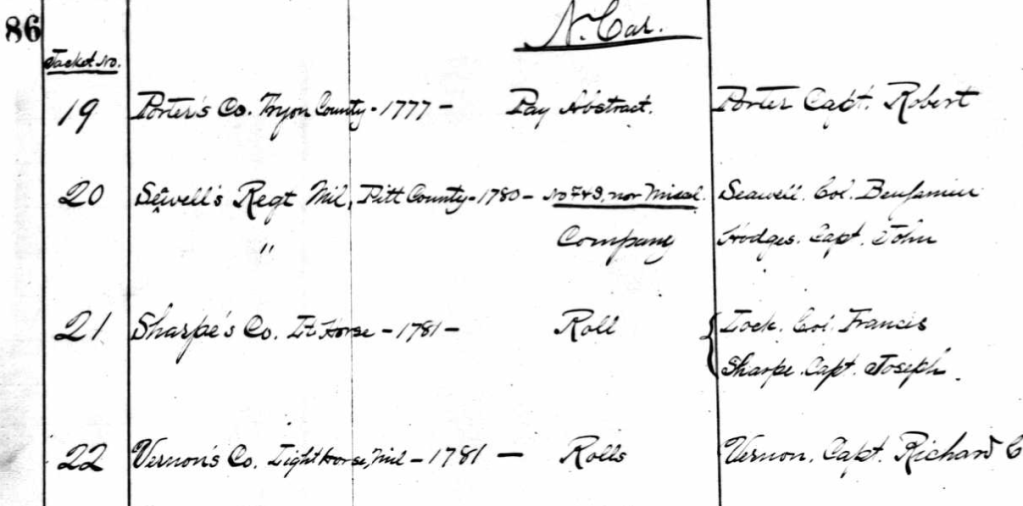
Revolutionary War Rolls, 1775-1783: Capt. Robert Porter’s Name on upper right.

So this left Margaret Lindsay Porter a young widow with eight children. The youngest child, James Lindsay Porter, was only one or two years old when his father died and the oldest child was probably about 17 or 18. At least three of the children married and moved to Blount County, Tennessee and Margaret moved there also – maybe with one of her children’s families. There were no records found that Margaret remarried after Robert’s death.

The only other record I found for Margaret indicated that she may have had a sad ending indeed. Margaret was appointed a guardian in 1803 according to Blount County TN court records. The reason for appointing a guardian was that Margaret was in “state of insanity!” Now “insanity” at that time was a label for multiple kinds of conditions including dementia. In the settlement records of her guardianship at her death in 1811, eight years later, reveals her guardian was a William Gillespie who was over 80 years old at the time like Margaret. This begs the question why an 80 plus year old man was her guardian when she had a number of married children living in the same area?

Some questions of the past can and will never be answered! However, I am grateful that I was able to find and tell part of the stories of my women ancestors!

Sources:

  • Wills; Delaware, Pennsylvania; Will Book, Vol. A-B, 1789-1822; Case: 41; Date: 2 May 1791; James Lindsay
  • Scotland, Select Births and Baptisms, 1564-1950 [database on-line]. Provo, UT, USA: Ancestry.com Operatons Inc., 2014.
  • Filby, P. William, ed. Passenger and Immigration Lists Index, 1500s-1900s. Farmington Hills, MI.
  • Ancestry.com Pennsylvania, U. S. Compiled Marriage Records, 1700-1821 [database on-line]. Provo, UT, USA: Ancestry.com Operations Inc., 2011.
  • Excerpts from Ewing Family Association: https://www.ewingfamilyassociation.org
  • U. S. Revolutionary War Rolls, 1775-1783 [database on-line]. Provo, UT, USA: Ancestry.com Operations Inc., 2007.

The Ewing Clan in History and Legend: Of Eagles Wings

#52 Ancestors: Family Legends

My research last week on James Robert Porter and Eleanor Gillespie inspired me to take another look at their son, Andrew Porter of 1720 who was my 7th Great-grandfather. He also was a Scot-Irish immigrant who made his way to America, namely Maryland, with his wife Eleanor Ewing. You can read more about them in this link to my older blog: Irish Ancestors and Immigrants! If you read last weeks blog, you know that I discovered that these ancestors were originally from Scotland and not Irish, and they only resettled in Ireland before immigrating.

This week, I want to reveal more about what I learned about Andrew Porter’s wife and my 7th Great-grandmother, Eleanor Ewing. She was the daughter of Alexander Ewing and Rebeckah ______. Andrew Porter’s parents were James Robert Porter and Margaret Ewing that I wrote about last week and you can find it here: A New Beginning: The Porters – Scots or Irish? That James Porter traveled to America with his uncle Alexander Ewing who was a brother to his mother Margaret Ewing Porter! His father was Josia Porter. Now that can be confusing but I saw a lot of Ewing names popping up in my research and I had to know more!

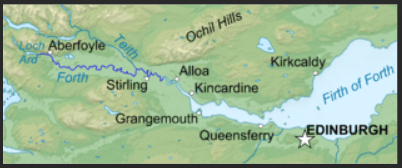
River Forth in Scotland showing location of Stirling Castle

Where did the Ewing’s come from? In reality the Ewings are of Scottish descent and originally from west of Scotland, near Glasgow and the clan was located on the River Forth. The River Forth was near the famous Stirling Castle in the vicinity of Loch Lomand. The Ewings were Presbyterian and in the mid 1600s, many protestants were being persecuted and a religious war ensued. Ultimately the Ewing clan chieftain was captured and executed and all of the clan were outlawed. The Ewing clan went from the River Forth area to the Isle of Bute, Scotland and later settled at or near Coleraine County, Londonderry, Ulster in northern Ireland. Of course this is a simplified version of the historical events.

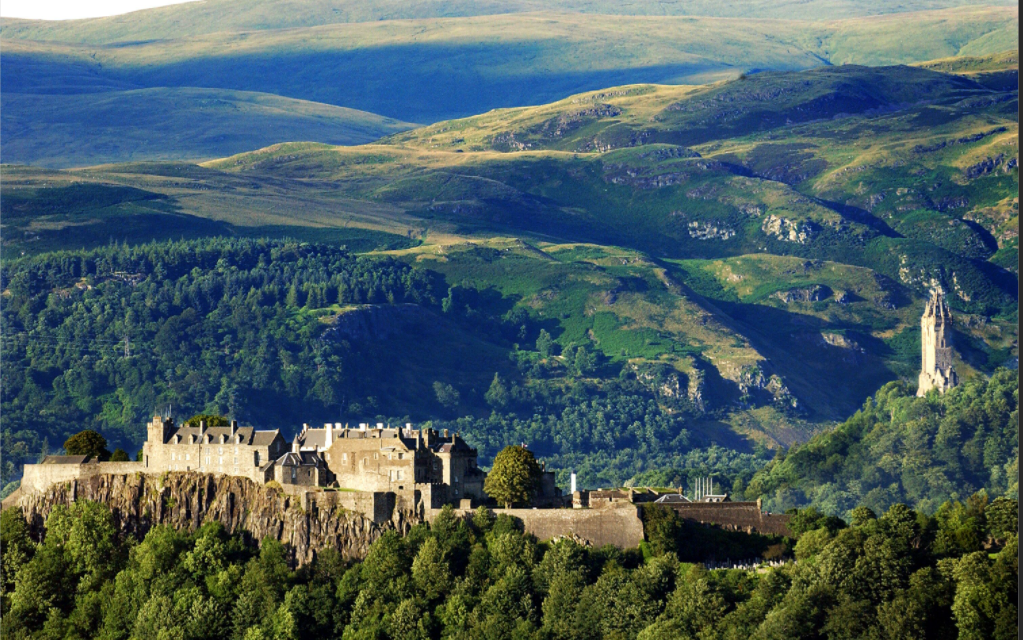
Stirling Castle still stands today and is a tourist site. It was built on a high cliff.
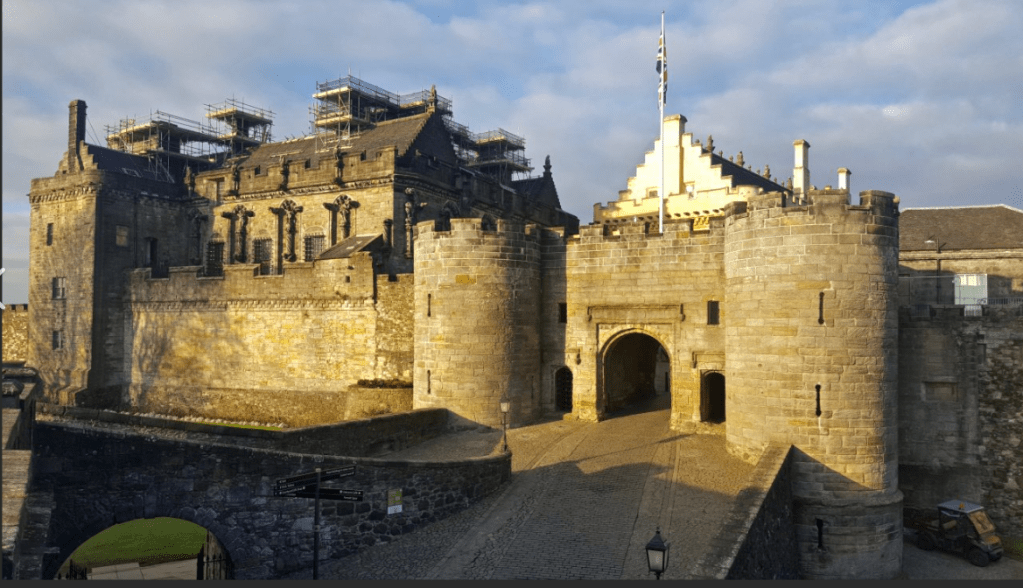
Stirling Castle

I found a family legend written to explain where the Ewing name came from – it was handed down through countless Ewing generations! ” In pre-Christian times, a group of Celts settled along the eastern shores of Loch Lomond in Scotland and became shepherds. Their peaceful settlement was plagued by the depredations of a huge eagle that stole their sheep. Finally an infant child was taken by the eagle. The eagle’s nest was in a precarious position under the overhand of a steep cliff, and one of the shepherds was lowered by rope to attempt to kill this bird that had caused them such injury. Unable to hoist the whole of the eagle’s corpse back to the clifftop, the shepherd brought back with him one of eagle’s wings to prove that his mission had been accomplished successfully. The group of Celtic shepherds began to call themselves the Eagle Wing Clan. This Clan name was shortened to E-wing and finally to Ewing. “

Now whether you choose to believe the Eagle story or not, it is up to you. Lets go back to Eleanor Ewing, wife of Andrew Porter of 1720. Eleanor was born about 1721 in Ulster, Ireland and her parent were Alexander Ewing and Rebeckah – mother’s surname is unknown. Eleanor and Andrew married about 1738 in Cecil County, Maryland (then a British Colony). Eleanor has a tragic story. Unfortunately, Eleanor died two years later in 1740 in child birth or a short time after their son Robert Porter was born. This Robert Porter, her one and only child, became my 6th Great Grandfather and fought in the Revolutionary War. Andrew had to bury his young wife of about 20 years old but later remarried a Margaret Leiper and had six more children. More on Robert Porter will come.

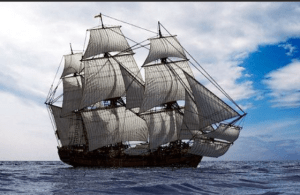
1700s Sailing Ship

It is quite possible that Eleanor Ewing came to America around 1727, and based on a statement in “Clan Ewing of Scotland,” a group of Ewing, Porter, Gillespie, Caldwell and other families came to America in that year. Two of the ships that the immigrants used to traverse the ocean were named Eagle Wing (sound familiar?) and Rising Sun. Most of our ancestors did not come at the same time nor did all come in the same ship.

But what were some of the motivations behind the immigration? Surely a big one was to escape religious persecution and settle in Maryland, Pennsylvania and also Philadelphia who were founded on religious freedoms. In Ireland, between the years of 1720 and 1730, the harvests were very poor and crop failures surely contributed to the causes that inspired families to consider making the long voyage to America and start a new life. Landlords were also raising leases on land and calling in loans.

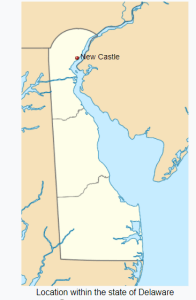
Some family tradition believe that after a tedious voyage, the ships may have landed at New Castle on the Delaware River which was near Cecil County, Maryland where so many Ewings and Porters settled. New Castle was only about fifteen miles from Cecil County border. More ships were built as a result to carry passengers and goods to America because of the large number of immigrants in the 1700’s up to the Revolutionary War in 1776. The Eagle Wing served to more than 35 years between Belfast, Ireland and American ports. It was a fast and modern sailing ship for its time and could make the trip across the ocean in seven to ten weeks if all went well!

Seven to ten weeks on the Ocean in a crowded ship does not seem like a pleasant journey so I have to commend our ancestors for taking that tedious voyage to America!

Sources:

https://www.geni.com/surnames/ewing Also: http://www.sandcastles.net/ewing.htm

Irish Immigrant Families: Porter, Ewing, Gilliespies; Posted by William Gammon: Ancestry.com

Ewing, Elbert William R; Clan Ewing of Scotland. Ballston, Virginia: Cobden Publishing co, 1922; p. 176.

Ancestry.com. John Ewing, Immigrant from Ireland 1660-1974 [database on-line]. Provo, UT: Ancestry Operations Inc.

McMichael, James R; Alexander Ewing (1697/7-1738) & descendants: Ireland to America in 1727; Bountiful Utah: Family History Publishers; Spring, TX, 1999.

A New Beginning: The Porters – Scots or Irish?

#52 Ancestors Each week of the year Amy Johnson Crow publishes a theme or prompt to provide inspiration for working on our genealogy. We can choose to write, post or do something else related to our research such as organizing family photos. Although I am a bit late in starting writing this year as I was working on other research, I will consider her suggestions each week and write about the ones that inspire me! Her first theme was “Beginnings.”

At the beginning of the new year, it is a good time to think of how our ancestors came to America for so many different reasons. One thing in common is that when they set foot on our shores, they all began a new life – a new beginning. I have been researching the Porter family ancestors who sailed from Ireland. The reason I wanted to take another look at my research was that my DNA profile showed little Irish (about 5 %) and twice as much Scottish (10-13%) ancestry. So I thought it would be good to review the ancestors I believed were Irish.

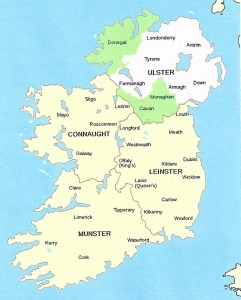
Ulster County in 1700s, now part of Northern Ireland

Among the thousands of immigrants in the 1700s, there were three clans that immigrated from Ulster County, Ireland and settled in the Maryland area, particularly Cecil County. All three clans were close neighbors and great friends and intermarried often both in Ireland and America. The clans were the Porters, the Ewings and the Gillespies families. By tracing my ancestry, I found that I am related to all three clans in one way or another. Now I had thought that they were all of Irish descent coming from Ireland but in reality many were Scots-Irish!

Scots-Irish is really an Americanism and not used in Europe and Britain where they are sometimes called Ulster Scots. The Scots-Irish refers to people whose ancestors originated in Scotland but who lived in Ireland, sometimes for several generations, before emigrating to America. The Scots started to go to Ireland starting around 1600 as an expanding population in Scotland hungered for more and better land and escape from religious persecution. The northern part of Ireland was fertile and sparsely settled and, besides, it was a short journey of just a few miles across the sea from the lowlands of Scotland. Most Scots settled in the area of Ulster and Donegal counties which includes all the counties of Northern Ireland today. Eventually the British government required all crown officials be of Anglican faith which excluded the Scots-Irish from any sort of power as they were devoutly Presbyterian. Even their clergy couldn’t perform marriages! Then came raising of land rents, drought, sheep diseases and smallpox that took a toll on the population. Of course there is much more history to this situation and too much to detail here.

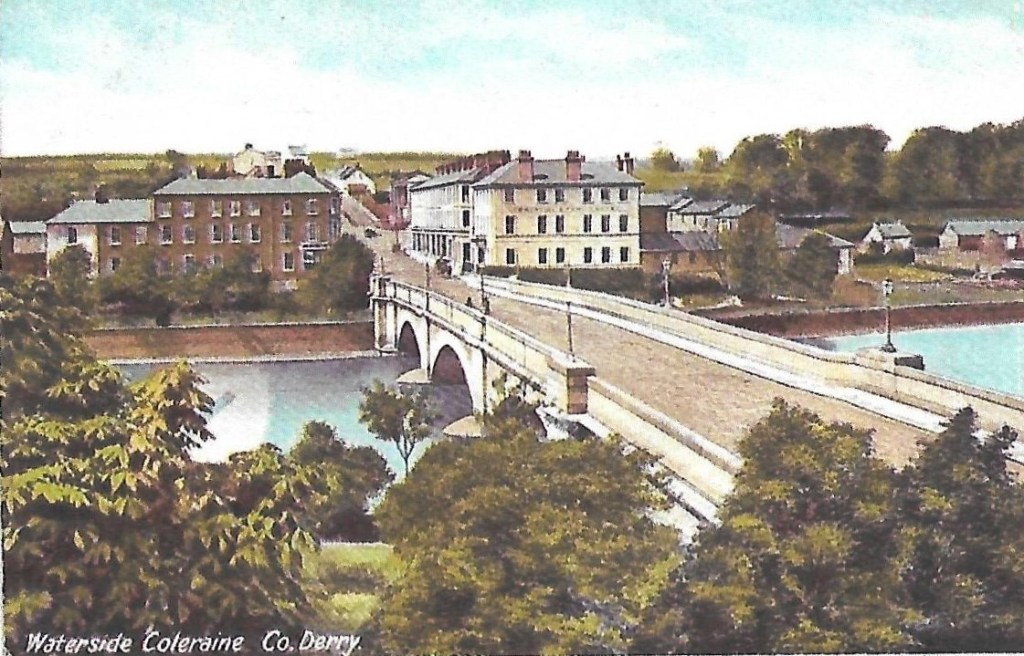
The emigration to the American Colonies began around 1718 and continued until the American Revolution. Most early immigrants went to Pennsylvania where the Quakers were tolerant of other religions or to Maryland or to Philadelphia. Eventually they followed the Great Wagon Road from Pennsylvania into Georgia with many stopping to settle in the Shenandoah area of Virginia like our ancestors. The first Scots-Irish ancestor of ours to come to America was James Robert Porter. He was born in Coleraine, Londonderry County, Ulster, Ireland in 1699.

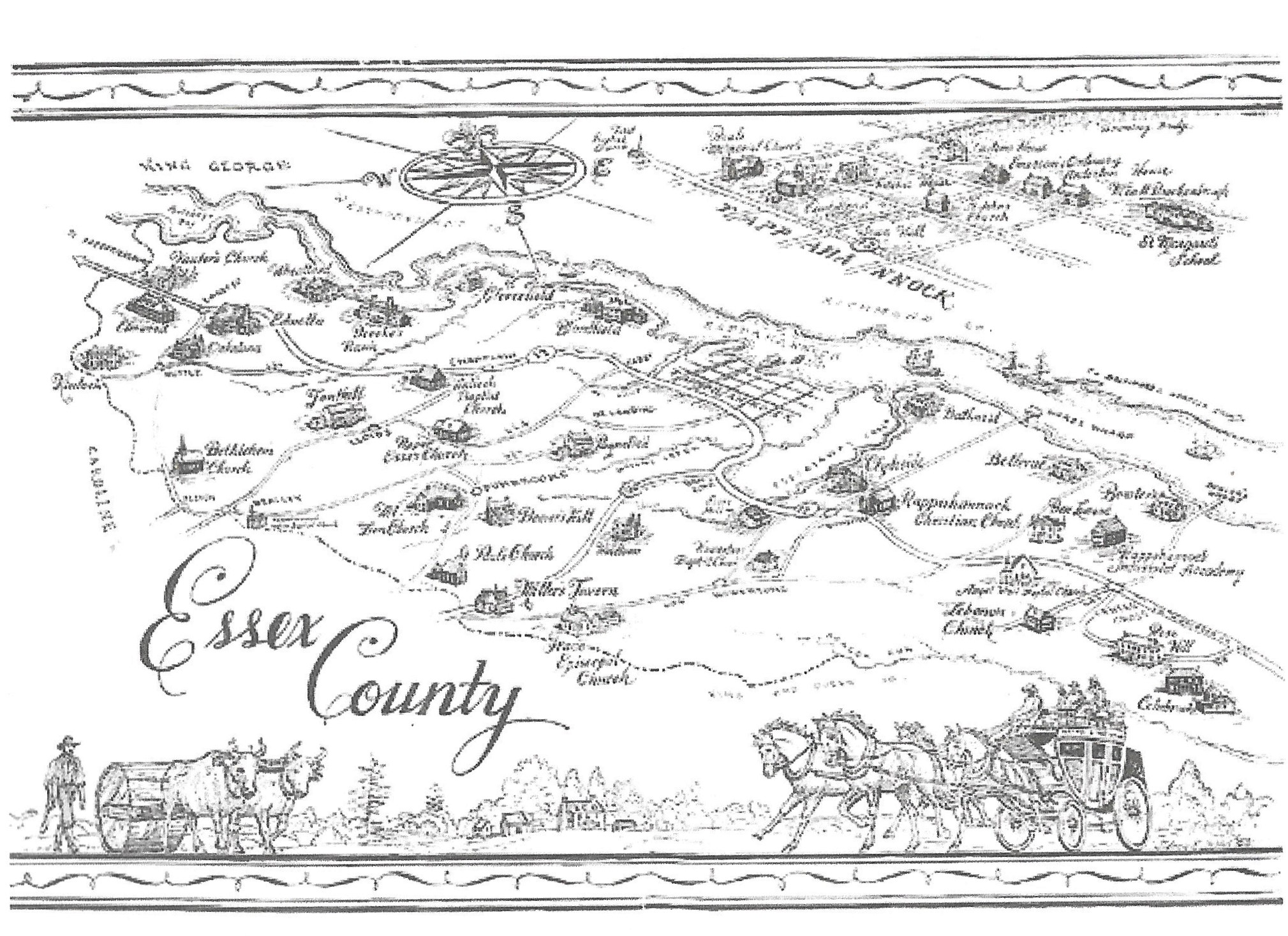
James Robert Porter was born in Coleraine, Londonderry, Ulster, Ireland. It probably wasn’t this developed in 1699!
James Porter was the son of Josia Porter and Margaret Ewing, both of County Donegal, Ireland. James married Ellen (also called Eleanor) Gillespie in Ireland – recall that I said the Porter, Ewing and Gillespie families were all intertwined! The Ewings, as a clan, were banned in Scotland as they were Protestants. It is thought that James Porter emigrated to the British Colony of Maryland in 1727 and that he traveled with his uncle Alexander Ewing, his mother’s brother. (Alexander and Margaret Ewing were children of Robert Milford Ewing and Rebecca Ewing. ) Later, James Porter’s wife, Ellen, traveled to Maryland to join him along with their children and her parents. I haven’t found her parents names as yet. All together, James and Ellen had ten known children, Jane, Mary, Elianor (also called Nelly), Betsey, Stephen, George, Andrew, William, James and Samuel.
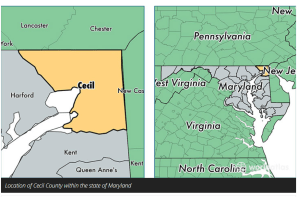
The location of Cecil County in present day Maryland

The Porter family, once reunited, settled in Cecil, Maryland Colony and there is a deed recorded for James. James bought 235 acres of land for 130 pounds from Thomas Love. On the deed, James Porter reserved the liberty of having a wagon road leading from his dwelling house through the granted land to where the school house now stands. This deed was recorded on 26 Mar of 1753.

I also found a 1740 petition from the inhabitants of Little Britain ( a township nearby in Cecil County) to establish a road that ran by “James Porters store” on the Octarara Hundred (land designation in Colonial times). This indicates that James likely owned and ran a store and was a merchant. He was indicated as a merchant in several documents and listed as the “brother of Rachel Porter Ewing wife of Nathaniel Ewing.” This reveals that his sister and brother-in-law also came to America. In 1784, their daughter Jane Porter, who was married to Patrick Ewing, died and therefore was not mentioned in James’ will. James also had a ferry service and a saw mill which his children inherited.

James Porter died around 1778 as his will was probated in 1778-1780. Because he owned land that was in Lancaster County, Pennsylvania and in Cecil County, Maryland, his will was probated in both counties. The will is also evidence of his prosperity in life. His wife, named Elianor in the will, got the land they lived on of course and 100 pounds of Pennsylvania currency plus her choice of one cow, horse or mare out of James’ stock. However, I found an unusual stipulation in the will stating that she was prohibited from “committing any waste or cutting any wood save what may be necessary for Rails and firewood.” Sons William and Andrew gained land, houses and building in “Peach Bottom” and that land contained a saw mill dam, races, and a ferry service. Son William also got a silver watch and other sons Stephen, James, Samuel and George received lands while the daughters Elianor, Mary and Elizabeth got sums of money.

I have not found any documentation on where James or Ellen (Elianor) Porter were buried. Judging from their prosperity though after coming to America, they did have a very good new beginning! By researching this family, I found some answers for my own ancestry too!

Sources:

  • Maryland, Cecil County, Deed Book VII, page 497. (James Porter of Cecil Co.)
  • Book I; Land Commissions of Cecil Co., MD 1724-1751, pp. 265-270.
  • Fife, Margaret Ewing, Ewing in Early America; Chapter XXIV, pp. 176 & 186.
  • Cecil County, Maryland; Will Book 3, 1777-1780; pages 63-68, 78-79.
  • Lancaster County, Pennsylvania; Will Book E, pages 299-301.
  • Garstka, Katharine, The Scots-Irish in the Southern United States: An Overview; Oct 16, 2009, (online).

Theft in the Graveyard: John James

#52ancestors    Week 21: Tombstone

“It was just a six-foot slab of marble engraved with a few dozen words.   Two hundred years of harsh weather had deteriorated its once polished appearance and centuries of undergrowth and weeds had captured nearby surroundings.  But it was the James family’s only connection to their Revolutionary War-era relative.  And now it’s gone –stolen–swiped from its eternal resting place.”

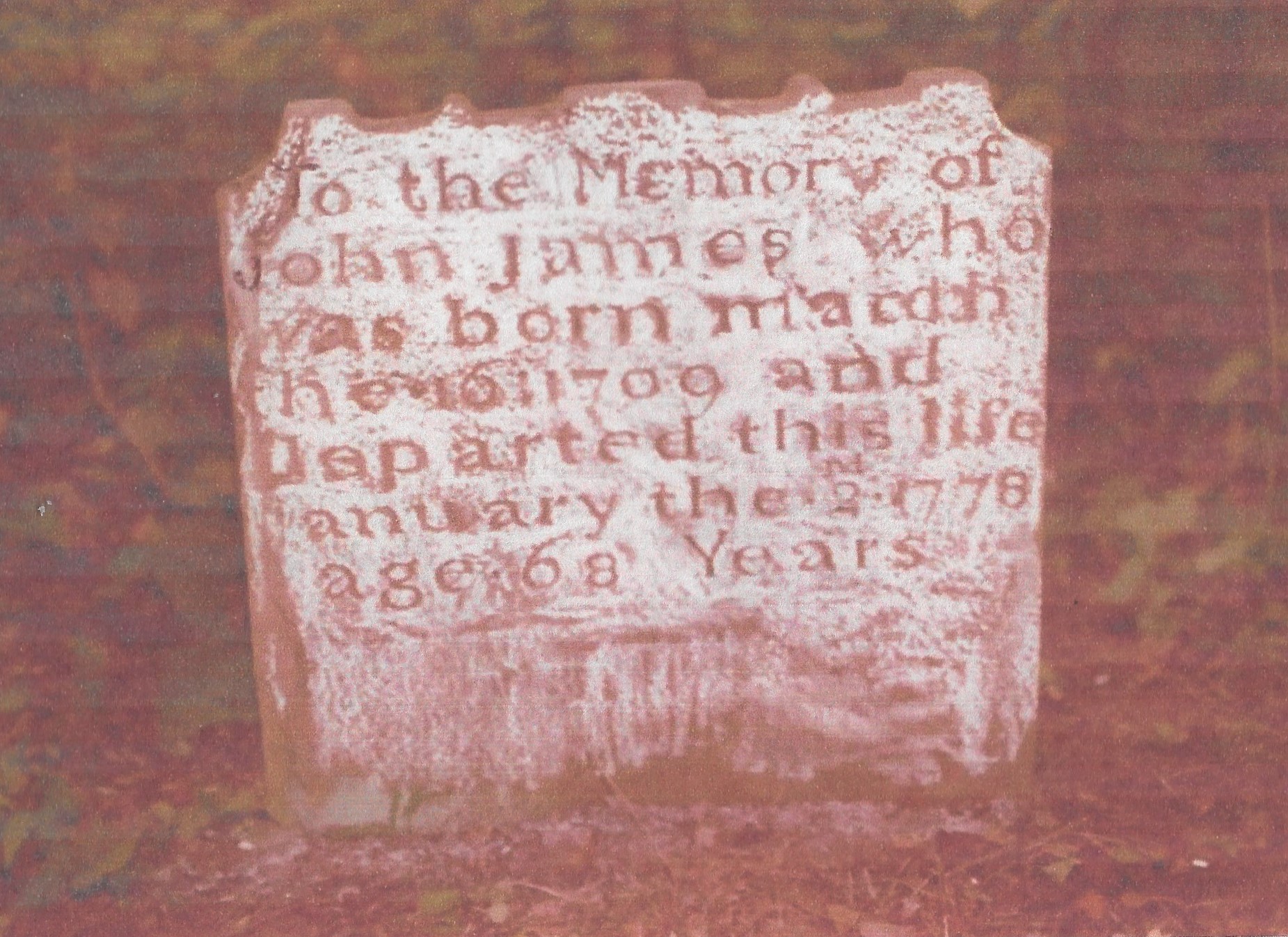
This is the beginning of a newspaper article written by Cathy Dyson for the Fauquier Democrat on February 16, 1984.  I found this clipping while researching my seventh great-grandfather, Capt. John James — it was his tombstone that was stolen!  I managed to find a picture of the tombstone that was taken before the tragic theft.

James, John, gravestone, 1778, Elk Run, Fauquier VA 001

As eerie as stealing tombstones sounds, I found out that thefts do happen and are surprisingly common.  There is actually a sort of “black market” for them and old stones are like antiquities.  I suppose a Revolutionary War stone of an officer like Capt. John James would be valued pretty high.

So who was this John James?  According to my photo of the stone, he was born “March  the 16, 1709 and departed this life January the 2, 1778 age 68 years.”  The dates correlate perfectly with the information I had already uncovered, verifying for me that this was indeed my ancestor.  John was born in Elk Run, Stafford County, Virginia Colony, and was the son of Thomas James and Elizabeth Mason Barbee (widow of Andrew Barbee).   The grandfather of Capt. John James was also named John James (go figure!), and this John immigrated from Caenarvan, Wales around 1650 and married Elizabeth Underwood.

The title of Captain wasn’t just bestowed on him as he earned his rank in the Fauquier County Militia which fought in the Revolutionary War.  He also served in the French and Indian War.  He is on the DAR list of patriots.  But, of course, there is more than his military service to distinguish him.  Capt. John James was one of the first pioneers of Fauquier County, Virginia, and he owned many, many acres in the Elk Run area.  He was also a vestryman of Hamilton Parish in the County and appointed road surveyor in 1758.

Capt. John married twice with the first marriage in 1727 to Ann Sebastian in St. Paul’s Parish, Stafford County, Virginia Colony.  Ann died before 1738 and John then married Dinah Allen in 1738 in St. Paul’s Parish.  Dinah outlived John and died in 1800.   They do seem to have been wealthy judging by John’s will probated in 1778.  He bequeathed 500 acres of land to each of his four sons and there were still acres of land left for his wife to live on.  When she died, the remainder of the land and estate passed to the seven daughters.  His last will and testament revealed a number of possessions – horses, hogs, calves, wagons, sheep, feather beds and furniture, and 17 slaves.

Capt. John James’ tombstone is still missing as far as I know.  The Fauquier County Sheriff’s Department did investigate the theft but turned up little information in 1984.  The fourth great-grandson of John, Bill James, who is an area resident, made a public appeal for the missing marker.  He stated “I would hope that people would understand the significance of the tombstone and what it means to the James family.  Maybe the tombstone will reappear as mysteriously as it vanished.”  The stone was last seen in July of 1983.

I am thinking that John James’ tombstone is probably now being used as a unique coffee table or an ornamental patio decoration.  What else could you use a gravestone for?  It has such historical value for the James family, it is really sad that it was taken from them.  Another tidbit of information came from the article I read.  Because John James was the eighth great-grandson of Col. John Washington, Mr. Bill James is the first cousin, eight times removed, of George Washington.   Could that mean that I am also related to George Washington?  Hm-m-m, time for more research!


John “the Ranger” Taliaferro: Exemplary Service!

#52ancestors     Week 19: Service

This week’s writing prompt for 52 Ancestors is “Service.”  It made me think of John “the Ranger” Taliaferro as he was an excellent example of service – service in the military and in the community!   I recently have been researching John “the Ranger” Taliaferro and his wife, Sarah Susan Smith, as they are my seventh great-grandparents.  John and Sarah were the parents of John of Snow Creek who I recently posted a blog about.  You can see it here: John Taliaferro of Snow Creek

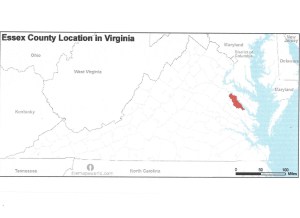
John ” the Ranger” Taliaferro was born 24 January 1655 in Powhatan, Essex County, Virginia Colony.  John was the son of Robert Taliaferro (1626-1671) and Katherine Grymes Dedman.  When John was about 27 years old in 1682, he married his cousin, Sarah Susan Smith, the daughter of Major Lawrence Smith and Mary Hitchon.   Sarah was born on the first of January 1659 in York, Essex, Virginia Colony.  Sarah was about 22 years old at the time of marriage and together they had eleven known children.

Essex County VA location in VA map 001

The first thing I wanted to find out about John is why he was dubbed “the Ranger.”   I found out that John served as a lieutenant in a company of the York Country Rangers raised to fight off the Native Americans in Essex County in 1692.  After his service, John earned the moniker “the Ranger” which did help to distinguish him from his son, John of Snow Creek!  Ten years earlier in the summer of 1682, he joined with Cadwallder Jones to range the great fork of the Rappahannock River.  They were early explorers of the first heads or springs of the two branches of the river and they also crossed the Blue Ridge Mountains to camp on the banks of the Shenandoah River.   This was a daring and dangerous feat to explore unknown territory at the time!

Essex County VA in 1700s 001

John continued his service to his community by taking the position of Sheriff in Essex County in 1692.  In 1699, John served as a burgess in the House of Burgesses for Essex County, and also served as a justice in Essex County between 1699 and 1700 and again in 1702, along with Francis Taliaferro (his uncle).

Taliaferro, John the ranger, Powhatan house 001
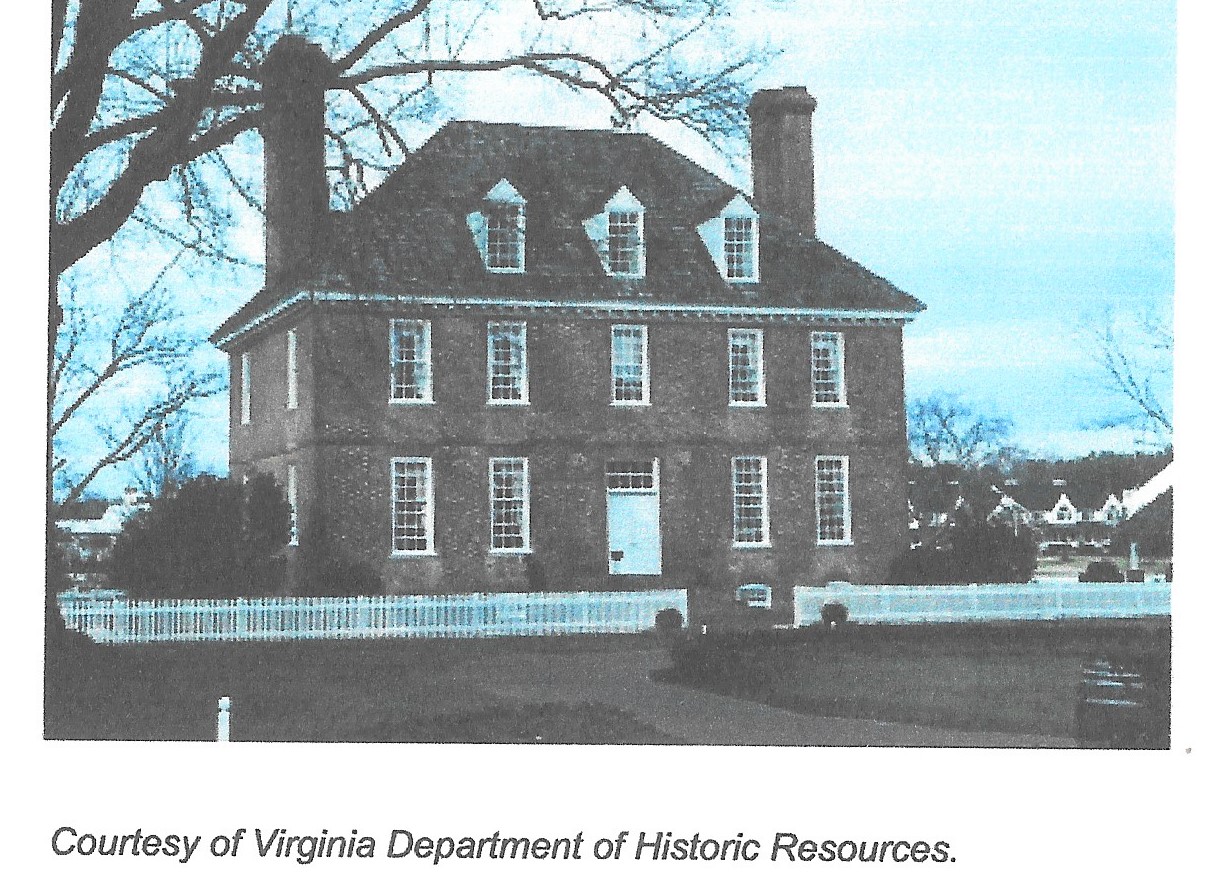
Powhatan House in James City County, Virginia, and former Taliaferro residence.

John and Sarah were large landholders in Essex County and had built a beautiful house on their Powhatan Plantation.  The bricks for the house were made in England.  At the time of their marriage, John’s brother, Francis Taliferro, who was the son and heir of their father Robert Taliaferro, gave 1,000 acres of land to the newlyweds.  As time went on, John was able to amass much more land.  Today Powhatan is in James City County not far from Jamestown and Williamsburg, VA.  It is a historic building.
**NOTE: I have since discovered that Pohattan was built in 1740-1750 by John’s first cousin, Richard Taliaferro, not by John the Ranger.  Richard Taliaferro was a famed architect in the city of Williamsburg, Virginia.  Thanks to several readers who alerted me to this error! (8 Oct 2021)

The will of John Taliaferro, Gentleman, of the Parish of St. Mary’s in Essex County was dated June 1, 1715, and John died on June 21, 1720.  His wife, Sarah, died around the same year.  All of their eleven children were named in his will.  One would think that by naming his children in the will, it would be easy to trace and research each of them.  However, that is not the case!  His brother, Francis, who married Elizabeth Catlett, also had a large family at the time and it seems that quite a few of his children had the same names as some of John and Sarah’s children.  Some of the duplicate names of John and Francis’ children that I found include Richard, Zachariah, John, Elizabeth, Robert, and William.  Since all the cousins were contemporaries, I must check all facts carefully to determine which family each belongs to!  It makes research on the Taliaferro families a bit more tedious, to say the least!

Sources:

  • The National Cyclopedia of American Biography:  Being the History of the United States. James T. White and Company, 1898. Vol. VIII, Page 161.
  • Western Explorations in Virginia Between Leederer and Spotswood.  citing John Taliaferro in An American Family History (on-line).
  • Mackenzie, George Norbury, and Nelson Osgood Rhoades, editors.  Colonial Families of the United States of America: in Which is Given the History, Genealogy, and Armorial Bearings of Colonial Families Who Settled in the American Colonies From the Time of the Settlement of Jamestown, 13th May 1607, to the Battle of Lexington, 19th April 1775. , 1607-1775.  7 Volumes, 1912.  Reprinted, Baltimore: Genealogical Publishing Co., Inc. 1966, 1995; Page: 138.
  • The Kinnear’s and their kin: a memorial volume of history, biography and genealogy, with Revolution.  Ancestry.com. North American Family Histories, 1500-2000 [database on-line]. Provo, UT, USA:  Ancestry.com Operations, Inc., 2016. (Page: 515)
  • Headley, Robert K. Married Well and Often:  Marriages of the Northern Neck of Virginia, 1649-1800.  Baltimore, MD, USA:  Genealogical Publishing Co., 2003; Page: 342.
  • 1717-1721 Essex County Virginia Wills, Inventories and Settlements of Estates No. 3; [John Frederick Dorman]: Pages 157-159.

Mount Airy, Mayberry, Siamese Twins and My Dudley Family

#52 Ancestors   Week 16    Air

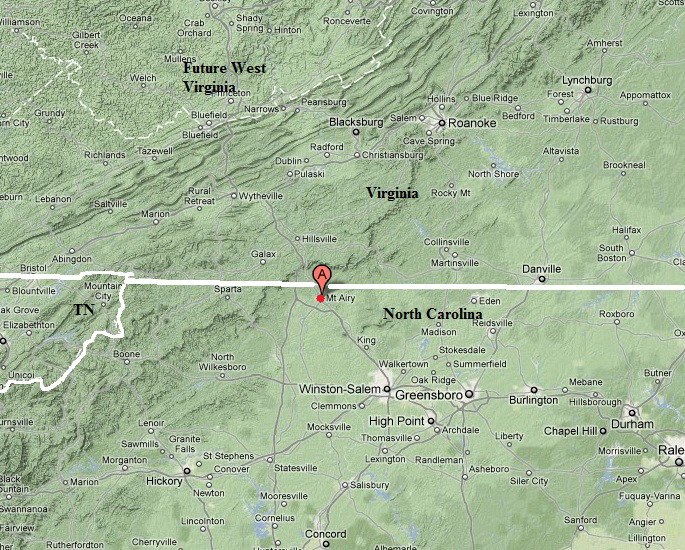
Mt Airy North Carolina map

Mount Airy, North Carolina has a couple “claims to fame.”  For one, it was the birthplace and hometown of actor Andy Griffith.  In his television show, the town of Mayberry was inspired by this town of Mount Airy nestled in the foothills of the Blue Ridge Mountains.  Another fact about the town is that it was the residence of Chang and Eng Bunker, the famed conjoined “Siamese Twins” who are buried just two miles from the main street.   Many of their descendants live in the area today.  In fact, the 200 acres of land acquired by Chang and Eng were previously owned by my ancestor and fifth great grandfather, Charles Dudley, in 1782!  (So very interesting!)

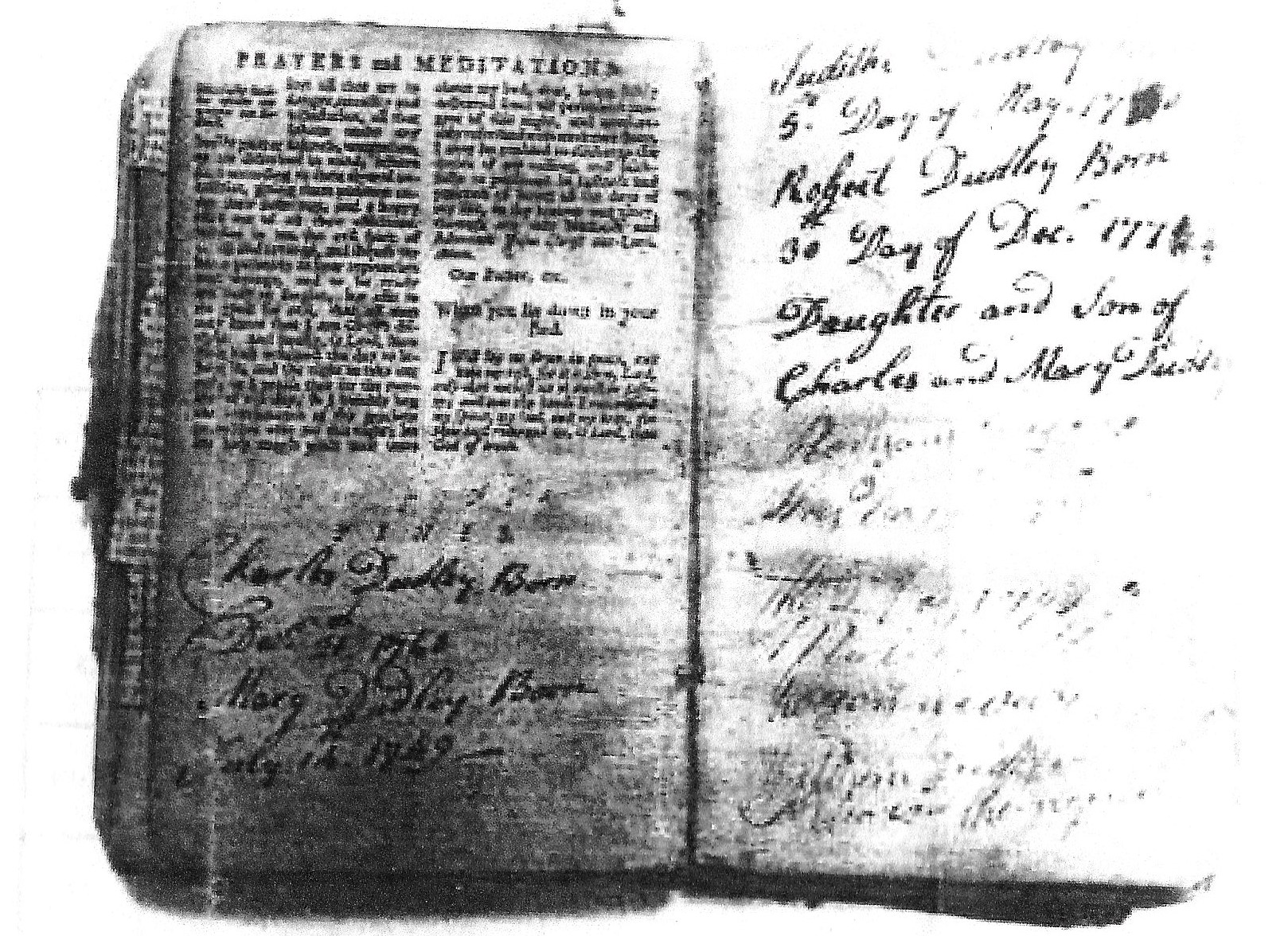
When I saw the prompt “Air,” I immediately thought of my ancestral Dudley Family who settled in Mount Airy, Surry County, North Carolina!  Charles Dudley and Robert Dudley, in particular, raised their families in that area.  Charles and Robert were originally from Caroline County, Virginia where Robert was born on 30 December 1772.   He was the son of Charles and Mary Dulyin.   Luckily, I can confirm Robert’s birth date as it was mentioned in his father’s Anglican Church Prayer Book and Psalms!   That was a great find, especially from the 1700s!


dudley, charles, bible record closeup 001
Charles Dudley’s Psalm Book noting births of himself, wife Mary, daughter Judith and son Robert Dudley. 


Before 1777, the Charles Dudley family moved to Surry County, North Carolina, just 3 miles south of the Virginia border, where Charles had received several land grants.  During the mid-to-late 1700s, the availability of land in North Carolina drew thousands of settlers from Virginia, Pennsylvania, and Maryland.  The process of patenting land in North Carolina was not really hard.  Anyone wanting to patent land just submitted an application or land entry to the land office and the land officer then issued a warrant. Surveyors surveyed the land and sketched a plat or map of the land claim which was filed in the land office or, after 1777, recorded by the county register of deeds.  Then the land patent was issued and recorded!

Charles Dudley’s first land grant Warrant of Survey is dated Nov. 21, 1777 in Surry County.  Three other grants at various dates were issued to him totaling about 1000 acres. Some of this land was on the Ararat River in Surry County and this is the river that flows through Mount Airy.  I am really puzzled as to the parentage of Charles.  One source claims he was the son of a wealthy nobleman in England but he ran away to seek adventure and went with a neighbor to America.  He established himself as a sort of sporting English Squire on his land and was a hospitable man who loved fast horses. You can read more about Charles in my post The Challenge of Finding Charles Dudley

Charles’ son Robert married a cousin named Clarissa Ross in about 1791 in North Carolina.  Clarissa was the daughter of Captain William Ross of Amherst County, VA and Rachel Coxey or Rachel Fugate (conflicting sources – needs more research!)  Clarissa’s family had also taken advantage of the land warrants offers in North Carolina.  Robert and Clarissa were both 19 when they married and went on to have ten children.  Their firstborn child was James Ransom Dudley, my third great-grandfather.  Robert and Clarissa did have their farm on Stuart Creek (Stewart’s Creek).  I found Robert’s name on the 1812 tax list for Surry County and, according to census records, they remained in the Mount Airy region.

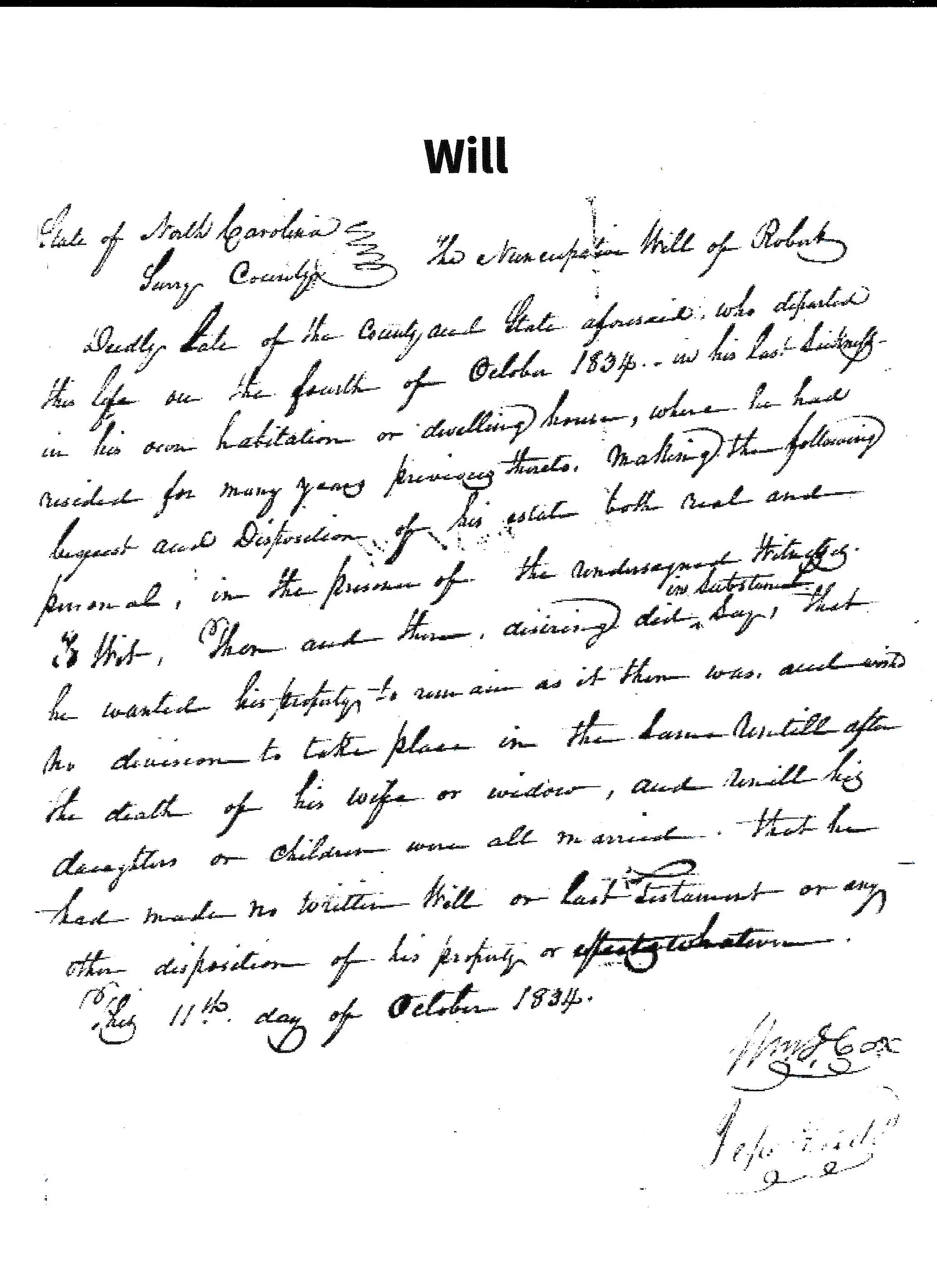
Robert died in 1834 and left a will (see below):


Dudley, Robert Will 001
Robert Dudley’s Will.


The important thing to note in the will is that he wished “his property to remain as it then was and wished no division take place in the same until after the death of his wife or widow and until his daughters or children are all married.”   However, four years later in 1828, there was a sale of his personal estate and his widow Clarissa was living with her daughter Betsy and son-in-law, Hardin Herring, so the wishes of Robert were not carried out as he stated in his will.   Perhaps there was an agreement by his children and widow to dispose of his estate in this manner.   Clarissa Dudley lived until 1860.  It is quite possible that they both were buried in the Herring-Dudley Cemetery in Mount Airy, North Carolina.

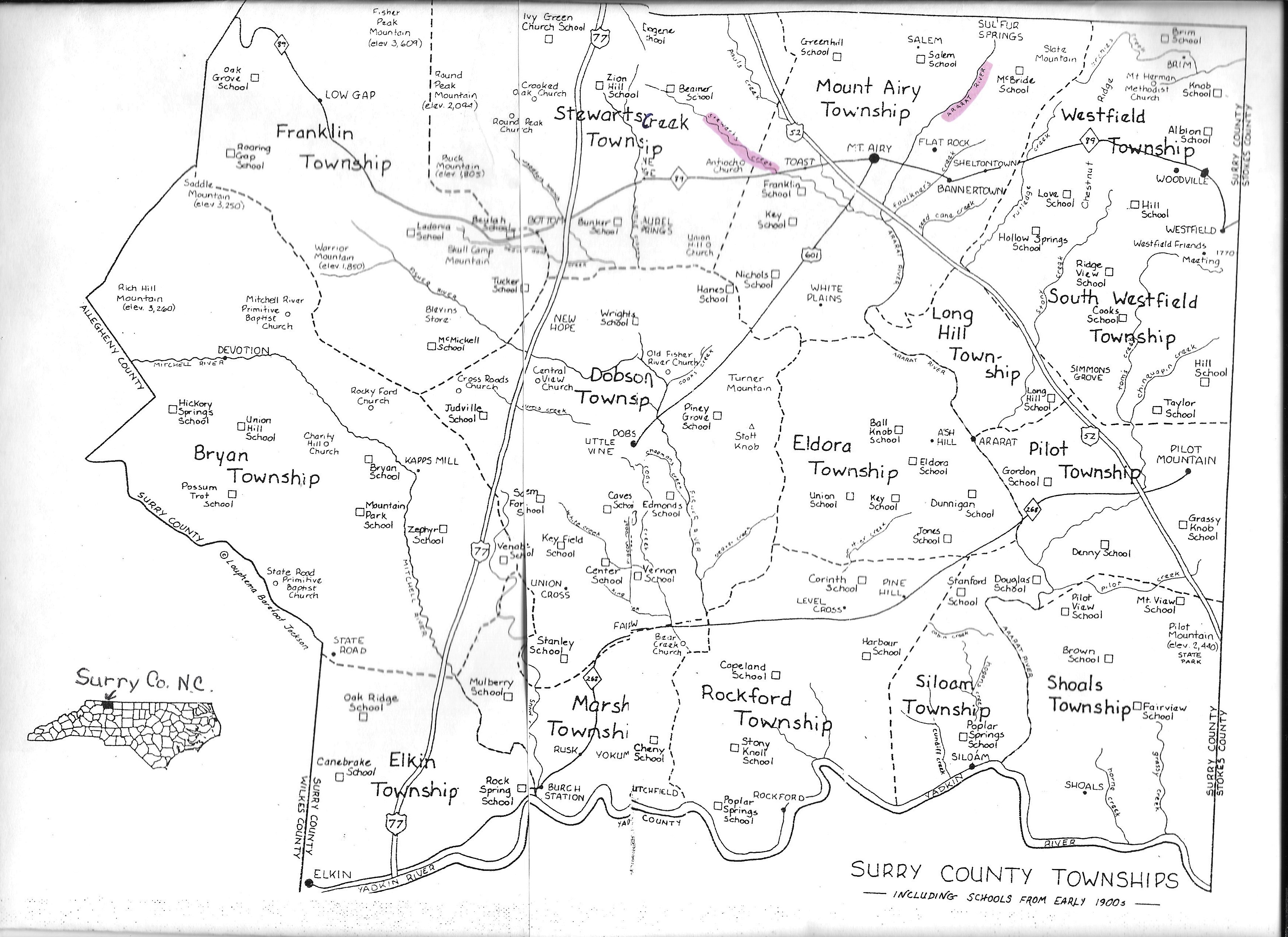
Mount Airy NC Twp Map 001
Map of Surry County Townships with Mount Airy at the top.  Highlighted rivers: Stewart’s Creek (left) where Robert Dudley owned land and the Ararat River where Charles Dudley owned land.


Sources:

  • The Heritage of Surry County; Surry County Historical Society, Family #209, P. 166.
  • Connor, R. D. W. History of North Carolina-North Carolina Biographies. Lewis Publishing Co., Chicago, New York, 1919, Vol. 5, p. 76.
  • Charles Dudley Family Bible Record, 1749-1830; State Archives of North Carolina; North Carolina Digital Collections.
  • Yates Publishing, U. S. and International Marriage Records, 1560-1900 [database on-line]. Provo, UT, USA:  Ancestry.com Operations, Inc., 2004.
  •  Wikipedia, citing Mount Airy, North Carolina.
  • Cerny, John & Mark, Gareth L: Red Book: American State, County, and Town Sources; North Carolina Land Records (Ancestry.com Wiki)